
 |
| ***Wall Sconce in Dining Room, "Winfield Hall"*** |
WEIGHT, color, decorative scale are perhaps the three most essential elements in determining the fitness of chandeliers, candelabra, floor standards, lamps and other accessories of modern electric lighting, either in private dwellings or in public places of assembly.
The apparent weight, the richness or lack of richness in color, and the size of the ornamental details are fundamental principles always apparent to the trained decorator's eye. But to the uninitiated, the words weight, color tone and decorative scale often have very little real significance when applied to lighting fixtures or house furnishings in general.
Because of this widespread lack of aesthetic discernment and artistic appreciation among modern home makers, it is customary to describe furniture, textiles and other necessary objects and materials about well-appointed homes in terms of the historic styles.
Little explanation is necessary to make the inexperienced understand that furniture was rather gorgeous and substantial in the time of Louis XIV; that it became festive in line and quite "feminine" in the days of Louis XV; that there was a return to more sober "classic" forms in the periods of Louis XVI; and that the "classic" forms were still further emphasized under Napoleonic influences. All this is convenient kindergarten talk for the designers of fine furniture. It has been comparatively easy to establish this world-wide rule of historic styles in the minds of modern home makers, because they are perfectly able to compare modern furniture and textiles with authentic examples of the several periods always on exhibition in our museums.
REVOLUTIONARY TREND OF LIGHTING AGENTS
WHEN one comes to design handsome lighting fixtures in the several styles, the problems of artists and practical lighting constructors seem much more difficult than the questions of design that confront furniture makers and textile manufacturers.
The usages to which chairs, tables, beds and nearly all varieties of upholstery materials are put today, are practically the same as when European civilization came into being.
The principal changes in domestic life that have influenced home making during the long centuries of Europe's upbuilding have been in some way associated with light and attendant sanitary improvements. On the use of lace as window curtains, the author pointed out the gradual evolution of modern windows and the greatly increased importance of window openings during the last two centuries. The development of the modern lighting fixture, on the other hand, has been ever so much more sudden than that of modern curtains and windows. Precedents in electric lighting are extremely difficult to establish, for unparalleled improvements and scientific discoveries have radically changed the world within the last thirty years.
HARMONIZING LIGHTS WITH PERIOD ROOMS
WE LIVE in an age of light. Every home maker wants more light in his domicile. While he may accept stylistic restrictions regarding his chairs and tables, when it comes to lighting fixtures the practical conditions of agreeable luminosity are, in the home maker's mind, all important. The cautious advice of architects and decorators is all too frequently disregarded when electric fixtures are under consideration. This revolutionary tendency among modern people is very often made a source of profit, in an unscrupulous manner, by the agents of certain electric lighting companies.
Second-class manufacturers of fixtures also profit by the home maker's confusion and "put it over" on careful, conservative competitors, by offering more brass and a greater number of sockets for less money. The leaders of the lighting fixture industry ought, even if merely as an act of self-preservation, to instigate an educational propaganda for a more intelligent popular understanding of chandeliers, lamps, wall brackets and similar electrical accessories, in relation to furniture and the varied problems of interior decoration. Undoubtedly, the stylistic use of electrical attachments will be the most successful way of relating lighting fixtures to furniture and architectural decoration.
To illustrate the skilful use of historical styles in decorative electrical illumination, the editors of Good Furniture Magazine publish the following interiors in which the modern use of light has been harmonized with elaborate "period" rooms.
STYLISTIC PATTERNS BROUGHT UP TO DATE
 |
| Crystal Chandelier of Palatial Character is the Outstanding Feature of the Music Room, and differs widely from other Types of Lights in the Woolworth Residence. |

IN CERTAIN instances, as in the use of elaborate crystal chandeliers in the music room, well-known patterns have been followed out quite faithfully, while in other eminently successful designs, new forms and shapes have been devised to meet the exigencies of "style" as well as to satisfy the practical requirements of the rooms. But these new forms and shapes being harmonious in apparent weight, color and ornamental scale are successfully incorporated in the several period schemes shown in the illustrations.
 |
| (1) This richly-carved Alabaster lamp, placed in the Main Hallway to break the heavy shadow cast by the Stairwell Lantern, prove a clever subsidiary light Source. |

 |
| (3) A Stairwell Lantern of Famous Italian Renaissance Design adds much to the sumptuous Effect of the Grand Stairway. |

The sumptuous lantern above the stair-well is similar in general pattern to thoroughly familiar and authentic lighting fixtures of the historical period suggested by the architectural details and the handsome furniture. Fitted with electricity, such a lantern gives far more light than in the days of the Italian renaissance, when such monumental lanterns were equipped either with huge candles or smoky, fat oil lamps. But even when equipped with our most modern appliances, the luminosity of such a fixture is either too dim or too concentrated in power for our twentieth century ideals. People dislike dark shadows and piercing lights, especially on stairways.
While this hanging lantern, with its handsome display of metal workers' craft, forms a ponderous, palatial and well-poised lighting center for a truly splendid hall, it is far from meeting the everyday requirements of modern lighting. So the decorators established subsidiary sources of light to break the heavy shadows that the lantern would likely cast.
A THE MODERN ANSWER TO AN AGE-OLD PROBLEM
A NOVEL lighting fixture that quite escapes casual observation in daylight, should be noted. It is placed at the left of the large door leading from the main hallway at the foot of the "Grand Escalier." This lighting fixture of richly carved alabaster carries a powerful electric bulb in the urn-shaped top. The translucent qualities of alabaster make it possible to entirely conceal a very powerful source of light at any level which the resources of the illuminator's experience suggests. High-powered electric bulbs are, as everybody knows, often hidden behind cornices or hung inside inverted bowls or metallic vases placed well above the level of the eye.
In a very lofty salon or especially in a palatial stair hall, such an arrangement of concealed lights is apt to leave the floor unpleasantly dark, concentrating the main light on the ceiling.
***
 |
| THE WORLD'S MOST BEAUTIFUL LOBBY - Hotel Commodore - New York City |
***
Sometimes, as in the lobby of the Hotel Commodore, this indirect radiation is most fascinating. In the hall and stairway illustrated in Figure 3, unpleasant effects might easily be produced through the careless use of open luminous vases or urns, because people mounting the stairway would certainly at some point look down on the raw and disagreeable electric bulb. So this alabaster urn, at the foot of the stairs where shadows are apt to fall, is an eminently useful piece of furniture.
In the lighting of this stairway, the period traditions of the past and the resources of modern ingenuity are successfully combined to give a splendid effect.
But the varied problems suggested prove beyond a doubt that it is far more difficult to select or design suitable lighting fixtures than to secure well-appointed chairs or tables. In furniture it suffices for the architect or decorator to say that he wishes a chair or table from this or that epoch of the period styles, and he is sure to get something that matches up fairly well with the architectural details of the place. On the other hand, the unimproved lighting fixtures of the period might be either a smoky oil lantern, or a chandelier always dripping wax, and with half the candles blowing out whenever the front door is opened.
A MARIE ANTOINETTE CHANDELIER
 |
(9) Another Contrast—the Marie Antoinette Chandelier, of surpassing Delicacy, in keeping with other Appointments of the Room.
|

 |
| (10) These finely modeled Lighting Devices in the Marie Antoinette Bed Room assume New and Charming Qualities when seen from different Points of View. |

IN STRIKING contrast to the majestic style expressed by the lighting fixtures shown in Figures 1 and 3, we have in the same mansion on Long Island, numerous light and airy forms of craftsmanship, utilized in contrasting decorative schemes, as in the Marie Antoinette bed room shown in Figures 9 and 10. The skilfully-wrought flowery details, the lightsome sprays of leaves and blossoms that decorate the almost fairylike chandeliers, illustrate the meaning of the words "apparent weight and color." Whereas the huge central light on the main stairway has the virtue of looking truly ponderous, and its well considered weight gives an added sense of dignity to the place, the virtue of the Marie Antoinette chandelier is that it looks lightsome and gay, hardly seeming to have any real weight. Indeed, the less that the lighting fixtures in this room appear to weigh, the better they conform to the architectural qualities of the place, as exemplified by the details above the door and along the walls, or that find agreeable expression in the well-chosen pieces of furniture. The same fairy-like patterns are utilized for the wall brackets with their delicately colored shades.
Whether one views these electric fixtures in relation with the mirrors and fireplace or in the close contact with the delicate suggestions of carvings about the room, the effect is always harmonious. These finely modeled pieces assume new and always charming qualities of decorative design when seen from different points of view.
Certainly, fine electric lighting fixtures are among the most eminent examples of modern craftsmanship which our century has produced, but the adroit artisans, craftsmen and welltrained designers work without applause. Their achievements are often slightly valued instead of being recognized as masterpieces of ingenuity. The best praise they now receive is that a competitor occasionally steals their patterns and brings them out in cheaper form, manufactured of inferior material in quantities, to sell at cutrate prices. It is a pity that the most gifted creators of modern lighting fixtures have been such a very timid crowd that our people fail to recognize the splendid form of art now being created to meet the requirements of "The Age of Light" and to satisfy the natural desires of home makers who now utilize the endless resources of electricity.
KEEPING IN ACCORD WITH ARCHITECTS' PLANS
 |
| (5) Ornate Wood-Carving on the Walls of the Dining Room finds ready reflection in the Lighting Devices, particularly in the Wall Brackets with their Brilliant Mirrors and Italianized Putti. |

IN FIGURE 5 we see another harmonious association of fine furniture, architectural details and lighting agents. While the chandelier and brackets in this room are less ponderous than the stair-well lantern, they are decidedly more substantial and magnificent than the ones shown in the airy bedroom, furnished in the style of Marie Antoinette. This difference in style corresponds in a happy manner to the wall decorations and to the architectural details, like the doorways and window mouldings.
By force of logic, lighting fixtures ought to be in closest accord with the architect's plans because the electrical devices, for the most part, are definitely attached to the structure of the building. While chairs and tables are easily moved about from one room to another and from an old home to a new one, chandeliers, wall brackets and all similar necessities to modern illumination remain, for the most part, where they are first placed, and are quite as much an integral part of the original decorative designs as are the ornamental wall mirrors or fireplaces.
The side table and accompanying ornament of this dining room established the dominant features of design that were followed in all its decorative details. The main chandelier is possibly a little lacking in the fanciful and ornate charm expressed by the carvings of the panel above the side table. But the wall brackets are delightful examples of the fixture maker's enchanting art.
In fact, the wall brackets, with their brilliant mirrors and their Italianized putti, supporting garlands of fruit and flowers, repeat as minor accents the major ornamental motives of the main composition. Such a spirited and intelligent adaptation of delightful patterns, to the practical exigencies of lighting, ought to receive widespread commendation, and will undoubtedly, in future days, seem to have marked an epoch for the history of lighting fixtures in the United States.
LIBRARY LIGHTS FOLLOW THE GOTHIC MODE
 |
| (6) The Restful Beauty of the Gothic Library is enhanced by the simplicity of the Chandelier. |

STILL another successful rendering of a historic style, adapted to modern circumstances, is clearly exemplified by Figure 6. Here the restful quality of the library is enhanced by the simple beauty of the chandeliers.
If the reader will compare the different types of lighting fixtures in this article, noting the different qualities of apparent weight, of curving lines, and of angular or substantial patterns, an instructive understanding of "the styles" is at once apparent. In every instance, the first purpose has been that of creating a thoroughly practical lighting system, but the final results have been in every case quite in harmony with the general architectural layout of each room.
In the past, all too frequently, the selecting of lighting fixtures has been either a matter of artistic ignorance or cultural despair. All too frequently the home maker's choice has been doomed because it has often been a question of selecting the least bad out of an unlovely lot.
The hope of finding electrical attachments on a similar artistic plane with the furniture and other decorative features of the interior has commonly been abandoned at the beginning of the search. This necessity continues, not because fine fixtures are not produced, but because the buying public has little chance of seeing them or finding out about their fitness and beauty.
 |
| (2) Mantel in the French Gothic Bed Room, with Wrought Iron Candlesticks which harmonize with the Chandelier and the Tall Candlesticks on the Dressing Table. |

The varied treatments of electrical appliances are capable of infinite refinement. For instance, the French Gothic bed room, shown in Figure 2, is somewhat similar in character to the Gothic mouldings and carvings of the library; but even the slight architectural differences of these two rooms have found expression in the enchanting mill craftsmanship employed to design the chandeliers, wall brackets and candelabra.
 |
| (7) In the Empire Bed Room, the Architectural Details, Furniture and Draperies make a Handsome Setting for the Modern Empire Chandelier. |

 |
| (4) Interesting Detail in Empirc Bed Room, with Side Lights contributing to the Doorway Decroration. |

The Empire bed room, with its elaborate twentieth century fixtures, shown in Figure 7, take on an added significance if we remember the enormous changes that have taken place since the creation of this style regarding what people in general consider adequate lighting for their homes. In Figure 4 the dresser, the mirror and the architectural details to the right and left all seem combined to give a handsome setting for electric lighting. Thus we see that all the historic styles may be skilfully adapted to the decorative handling of modern electric lighting.
COORDINATING USE OF LIGHTS AND MIRRORS
THE use of handsome candlesticks as table ornaments is a practical arrangement that has much to commend it to housekeepers, for it offers endless resources of decorative grace and charm when such candlesticks are suitably arranged with mirrors, wood carvings or other wall decorations. While neither the table with its candlesticks nor the wall mirrors in themselves are important enough to make imposing ornamental features if standing alone, when skilfully combined, as shown in Figure 2, such a composition may become the most decorative center in the room.
The mirror and frame makers, the furniture designers and the manufacturers of electric lighting fixtures ought to be trained in the same schools and should always work together with a common artistic purpose. They ought also to institute a common propaganda for a greater and more widespread appreciation of their artistic and decorative achievements.
The general use of mirrors in the homes of any but multimillionaires is a comparatively recent custom, because mirrors were formerly outrageously expensive. Only the expeditious methods of modern glass manufacturers have brought large mirrors practically within the reach of all. This use of large reflecting surfaces is an added resource for modern arrangements of well-designed illuminating attachments, and should be made much of.
TODAY we are overwhelmingly influenced by the splendor of the Orient. Above all, we are alert to the extensive color schemes which Oriental home furnishers employ so tastefully. Colorful objects are consequently being put to use by our merchants, manufacturers and artists.
 |
| (20) Allowing Color and Light to Dominate the Decorative Scheme. |
 |
| (18) Making Oriental Materials Serve American Taste. |
From China and Japan come many pieces of porcelain, and many pieces of enamel metal ware which we are able to adapt and incorporate in our electric lighting fixtures, as illustrated by Figures 18 and 20. Brilliant patterns worked out in silks and brocades, supplemented by highly ornamental fringes and tassels, have served to increase and greatly enhance the native beauty of imported craftsmanship from the Orient.
Inevitably, as we give more attention to our lighting fixtures, the important details of house furnishings come to play a greater decorative part in all the different uses to which they are put. By day, as well as by night, the lighting fixture is likely to become a dominant feature of our living room. Plain and otherwise unattractive wall surfaces may become extraordinarily brilliant and gracious through the introduction of an adequate wall bracket, as illustrated in Figure 15.
 |
| (15) Simple Wall Space in the Writing Room of the F. W. Woolworth Home are made Fancifully Attractive by Colorful Oriental Wall Brackets. |

This handsome room, designed by C. P. H. Gilbert, gives an idea of how the simplest wall space may become fancifully attractive through the utilization of Oriental color motives. The chandelier is still another indication of how modern systems of lighting lend themselves to artistic treatment, and to the varying character of architectural details. But no matter how one considers this handsome room, the wall panel with its mirror and its two electric lighting fixtures to the right and left, are bound to create a center of interest, and to remain one of the most important features of ornamentation.
 |
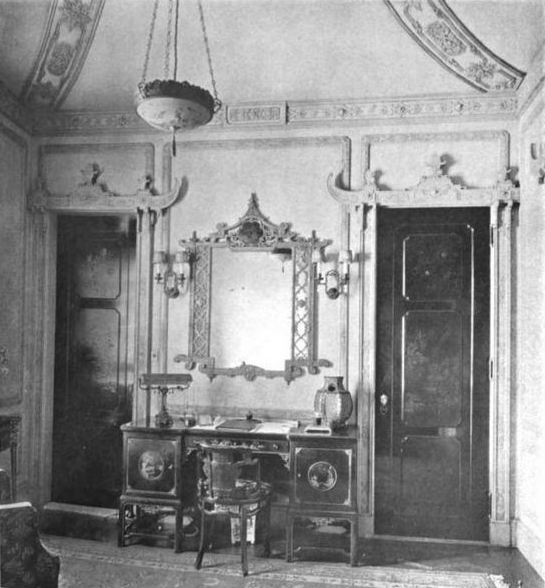
| (13) Centering lnterest by Means of Oriental Lighting Fixtures in the Chinese Bed Room of the F. W. Woolworth Residence, Glen Cove, L. I. |
 |
| (14) Lighting Fixtures in the Chinese Sleeping Room are Largely Decorative, a Powerful Bulb in the Central Pendent being the Real Light Source. |

Views of the Chinese bed room in this same sumptuous mansion, Figures 13 and 14, show us again how the modern lure of the Oriental is having a beneficial effect on our decorative schemes. The central chandelier in the sleeping room is ingeniously arranged, so that the pendant of metalwork of Oriental design carries within it a powerful electric lighting bulb, which sends an indirect radiation of light throughout the room. The small candlesticks which show us the visible signs of illumination are satisfactory in their color and style, but would be entirely inadequate as lighting agents, were it not for this large central bulb placed below the level of the eye in the deep pendant ornamental in form and coloring.
By WM. Laurel Harris- 1921

Click HERE to view past posts on "Winfield Hall".
Color photos lifted from the Location Department.


