***From Lobby to Peak - a series of illustrated articles in Our Continent - by Donald G. Mitchell - describing the New York City apartment of Louis Comfort Tiffany - progressing from room to room - Mitchell describes the essence of Tiffany's style - part eleven of eleven - published May 17, 1882***
WE had occasion in a previous paper to speak of folding-doors—of what might possibly be done to relieve their baldness, and by what devices the great opening which belongs to them might wear decorative treatment. We have now before us, in the larger of the two drawings, another opening of some six feet in width, serving as a passage-way from the library to parlor: it is needed also for free circulation of air, and needed for good distribution of light. But there are times, too, when it is needful to close this aperture for the purpose of securing privacy in one room or the other, yet without entire exclusion of the light.
A good ease, one might say, for an ordinary pair of doors with their upper halves glazed and opening in the usual matter-of-fact way. But in the present instance—the opening being near a corner—such doors, opened most whiles, would occupy needed space: nor could they be so deftly, and quietly, and unobtrusively closed, as a sudden influx of visitors to the parlor might make desirable.
Why not then the ordinary sliding folding-doors? Partly for the reason last named, and more urgently because the opening being near a corner there would lie only one way of
sliding, and still more urgently because the partition with which we have to deal here is a old eight-inch brick wall. What then? An adjustment of great convenience is needed
each cannot be met in the usual conventional ways. Is it not a capital occasion to over-leap conventionalities and set about the accomplishment of a desired purpose in the most simple and effective way without regard to the fashions of the modistes in house-furnishings?
Hence has come, for the needs set forth, that rolling screen which is somewhat rudely figured in the larger drawing. Its wheels, its hanging and its mode of adjustment are as
simple and as practical as the hanging of a barn-door: and if good and sound and little liable to dislocation in such humble and overworked connection, why not good and commendable, on occasions, in the privacy of home? Of course we would by no means advocate the transfer of the rattling iron trucks, and their paraphernalia of iron rails, from the stable to the house: but if convenience and the limitations of any particular apartment suggest this wheel method of moving door or screen, is there of any good reason against showing frankly and decorously as we can the wheels by which the easy movement sought is effected? It is all in the line of that honest show of constructive features of which we have already dropped a hint or two in our mention of pulleys and weights, and which in the comparatively old times of decorative talk made us welcome the best and sterlingest things in what was called the Eastlake furniture. Tis in the line too of the same large honesty which makes the exposure of the real grain of the wood (showing nature's constructive processes) commendable to all tasteful persons.
We observe indeed that Mr. Morris in his recent and most agreeable "Hopes and Fears for Art" (perhaps a little over weighted on the sentimental side) declares for covering up
"deal" with paint, because the English deal has no beautiful tint of its own. It is true indeed that the hybrid firs and pines which make up most of what is called deal in England
are without much character, certainly have far less than the white pine (Stubos) of our ordinary carpentry. This latter indeed, if adroitly chosen from the second cuts or sawings
next the exterior surface, shows beautiful convolutions of the which it were a sin to cover with heavy pigments. But whether deal or pine is subject of treatment, there are abundant transparent stains which may serve for multiplication of tints without obscuring that fibrous
structure of the wood which gives it life and character.
Nothing can be more certain we think, in regard to all decorative processes, as well as, all good architecture, that as we ripen to best accomplishment, constructive details, however homely or however common, will be more and more honestly declared, and imitations and concealments and pretenses go down. Good builders know how to make a water conductor upon the exterior of a house contributory to
architectural effect, and faraway back the water-spouts from the roof leads, under the name of gargoyles, gave charming play to Gothic fancies. Would it be very astonishing if some day water-pipes within doors were put into decorative twists or if gas-pipes or electric conductors show all their contours and serpents heads darting out jets of flame from shapely coils?
To such decorative times (If they ever come) will belong good honest hinges—of forged work maybe—in place of the best nutts which are best when most hidden, and an iron grip will be put upon the door frame which shall certify to strength and good service and which by its varying fashion shall pique the ingenuity and the art instincts of the workers in metal. Locks and latches will not be hidden in the thickness of the plank, but show delicate forged work and that ornamentation which, when applied in necessary every-day fixtures like these, is most engaging and most surely and helpfully decorative.
We come back now in our screen: it rims on wheels, as represented, there can be no good reason—whatever may be true of locks or hinges or pipes—for burying the wheels out of sight. Indeed in the present instance there is a very good reason for keeping them in sight, since their treatment, by which they are made to simulate an old-fashioned spinning-wheel, makes them mate admirably with the Japanese decorative whirls which appear upon the surface over which they travel, and with the kindred whirls of ornamentation (not shown in the drawing)which upon a golden ground play with a whimsical vagrancy over the whole stretch of frieze.
We observe again that this screen above the height of the dado is filled with ordinary glass of irregularly shaped rectangular panes (with other surroundings, a brilliant mosaic might supply its place), and this glass is shot over with a tracery of vines in some transparent pigment—perhaps some fantasy of spiders webs across the angles, mingling with the loose vine tracery, neither of these being very distinct and only taking decided form when the screen is drawn against the wall, whereon all this tracery of the glass is repeated in stronger color, in such way as to double the picture, line by line and tint by tint, so that a withdrawal of the screen across the opening does in fact unrip, or split, this vine picturing on glass and wall, showing then a transparent, flimsy tracery on the glass, against the parlor light beyond and on the wall a corresponding tracery in deeper tint. A light Japanese silken curtain is attached to the screen by brass rod and rings, and when extended over the glass (as in the drawing) hides the details we have brought to notice.
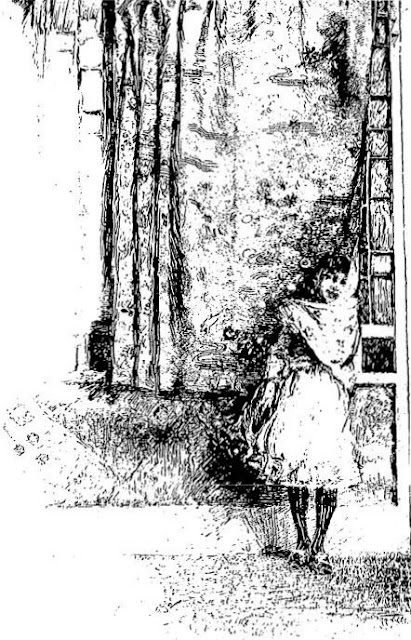
The lesser of the drawings shows a heavier curtain, partially covering a window, whose glare has been still further subdued by the painted transom against its upper quarter Upon this fixed and smaller glass screen are observable again the Japense whirls of figure which link it agreeably with frieze already mentioned. The little book-loving maiden below is seated in a chair to which it may be worth while to call attention as a type of the New England easy-chair of the middle of the last century, its fashioning being very homely, yet not unpicturesque, and its seat and back being formed by one continuous and sloping stretch of stout leather.

And now let us recount and group in consecutive array some of the features of this library-room, whose special aspects we have been considering. First, their is the broad opening between it and the sunny Breakfast-room, with dividing doors rarely closed, and in great casement of these doors dressed with masses of foliage; next, this foliage runs away in pretty vagrancy and in brown and golden tints over the dun-colored matting that forms the cover of the walls. Again, this matting is made fast by fillets of wood that by their arrangement leave rectangular panels, where paintings are framed and become an integral part of the decoration. A door, in most respects like other doors, has a couplet of little lacquered wickets opening in its upper panels to give glimpse of hall. The fireplace shows the massiveness of iron plates and the bold ornamentation of bolt-heads: a cupboard or two thereabout show iron panels treated simply with rust and lead and silver in patterns of flowers. Over these, books in all guises of back, and bric-a-brac of historic significance centralize interest and justify the title of Library. A screen moved at a touch upon its spindled wheels gives seclusion from the parlor beyond : transoms of colored glass moderate the obtrusive glare of the tall northern windows; a carpet whose severities of tint and figure make it wholly unnoticeable covers the floor: mystic, Oriental disks chase each other round the frieze, and a stanch table, and chairs as stamen have to library work.
Donald G. Mitchell.
Donald G. Mitchell was a close friend of Tiffany's. Our Continent was a new magazine covering history, literature, science and art. Click HERE to view all earlier posts on Tiffany's Bella penthouse apartment.
***From Lobby to Peak - a series of illustrated articles in Our Continent - by Donald G. Mitchell - describing the New York City apartment of Louis Comfort Tiffany - progressing from room to room - Mitchell describes the essence of Tiffany's style - part ten of eleven - published May 3, 1882***
IN the corner an Indo-Dutch chair, with its ebony or other wood covered with quaint incised work, and with a wealth of cushioned plush that is very inviting for dalliance with a "No-name" book, but too inviting for tussle with the Noxum Organum. There is no one rule which is good for the furnishing of all libraries. A chair to sit comfortably upon, a good lamp to see by, a solid table for note taking and a shelf for books are the essentials. One may vary these and complicate them as he may vary and complicate the furniture of his brain, only some symbols of brain-work should be present. Vases one would say should carry somewhat of historic or archaeological flavor about them, and Indian bric-a-brac, if there be such, should reflect a little of the " Light of Asia".

But what have we specially to note about our "Corner"? We observe upon the lower surface of the wall Japanese paper (imitation leather), laid on diagonally, showing differences of tone, but none of surface, as the drawing wrongly intimates. Above this the dado is made complete by two fillets of wood, and intersecting fillets enclosing little squares set of with thin Japanesque plates of metal. Nothing could possibly be simpler than this disposition of wood-finish, nothing easier of adjustment in the smallest or most modest house, and these enclosed squares chasing each other around the circuit of the walls might have their illuminations by home studies of color, might have a dance of silhouette figures, might show in a country home the whole series of wild flowers as they burst into bloom, and in a nursery might beguile the young folk with a procession of fairies, or "Forty Thieves", or Mother Goose's people, led off by Walter Crane*** illustrator*** or Miss Emmet. Again, these short strips of wood might be so adjusted as to receive glass slides, which might be put to practical use in covering dried flowers, or leaves, or grasses, so that one botanically inclined and puzzled for space might put his herbarium into decorative shape ; or, if a country liver, and entomologically bent, he could put his moths and butterflies into very effective show.
Above this range of squares, which we have dwelt upon, with what some may count a fantastic array of suggestions, without exhausting the half that occur to us, we find the matted wall-covering before noted, and its support by irregularly disposed strips of wood, these forming the very simple yet effective framework to two paintings—one of Colman, giving a look across the sheen of the Hudson to the Palisades, and the other a galaxy of some riotous blooming things.
As respects the matting, there may be said in its favor that its own dun tint is most agreeable, that it is inexpensive, that it carries for a long time a pleasant balsamic odor, that it has an air of great neatness and cleanliness, and that it takes most accommodatingly any pigment which even a home decorator may choose to put upon it.
On the other hand we anticipate a little objection making speech from the Mistress Plantagenets (who have brooms and dusters in the blood), to the effect that the open interstices of such a wall-cover will keep a great deal of floating dust which ordinary household service will not reach. In this there may be a measure of truth ; yet the objection will hold as strongly against velvety papers, and indeed all drapery.
We recur to the pictures and to their simple, economic frame-work. If good paintings will hear this treatment kindly, good engravings may hear it also; nay, the autotypes, or the chromos even, which make the rarest pictorial ventures of many a housekeeper, may take their places in such an easy, dexterous kind of paneling with very excellent effect; they may be brought "on the line" ; they may be accommodated with what space they demand ; they may be easily replaced, and the strips which form the frame (and which in most instances should have uniform tint, agreeing with the other wood investiture of the walls) may have, where necessary, a little interior and subordinate fillet of gilded or bronzed wood. These rectangular interspacings, too, give capital opportunity for the placement of maps—never bad addenda to library fittings; and the later and best German relief-maps, when judiciously and quietly tinted, have a picturesqueness of their own.
We note again, with respect to this simple way of breaking up bald wall-surface by economic exterior paneling, that it enables one to renew easily the wall-covering and to make home adjustment of it. A lively cretonne of good colors may supplant the matting: even old tapestry material may have its adjustments and joinings covered by these wood borders which form the paneling.
Of course care should be taken to establish the vertical strips upon the solid (beams) within the wall, and to this end it is always well, in any and all home walls, to mark, in some easily determined way, the exact position of the upright studding. This may be done by a diagram, or by markings upon the floor or washboard.
Observe too how easily this paneling will mate itself with any wish to establish temporary and exterior decoration. What a chance it gives for the adjustment of Christmas wreaths, or for the pretty festoons of lively and joyous drapery which some festal day in the family may invite! Young hands may drive nails in it without horrifying the master or the mistress. Isn't that a good homely residuum to have amidst all the whirl and flow of decorative intention?
Again, these strips of wood with their rectangular disposition may have a subdued ornamentation of their own. Cross-hatchings, home done, may show a little floral play left in relief; or the fillets may carry a hit of dentellated Venetian moulding, or a notched chevron finish, or (by the sea-shore with canvased interspaces) may show rope moulding and so give a snuff of sea things.
Yet, again, these dividing lines upon the wall may take on broader proportions, and join at top in a rectangular, basket-like lattice, to form a frieze within which some vine-like tracery may be set allow ; or still more homely and not untitling to walls of an extemporized home in the country, the members of this panel work may simulate the beams of construction, paired in the corners and showing diagonal braces or bolt-heads and the score of axes. So you may get something of the quaintness and picturesqueness of an old, country timber-house at an easy and manageable rate.
And now, leaving the walls, what shall we have to say of the two little doors of Japanese lacquer which open above the head of our "No-name" reader***Tiffany***? They give glimpse of the hall, and of the bit of mosaic there, which does duty in the ventilating shaft ; they give also, contrariwise, a glimpse from the hall of the library fire, of which fact we have already made note. Observe, also, that these are doors "in-door," and if closed would represent the upper ornamented panels of the larger door, to which they are attached. "Odd notion,"' you say. Aye, so it is. But why not doors within doors, as well as little ventilating loopholes of windows in larger windows? Nor is the matter wholly strange. Old country doors cut through horizontally in the middle, and thus excluding the colder air, and vagrant peafowl maybe, yet giving free ventilation and a good, serviceable leaning post for the country master, what time he lazes their upon his elbows, snuffing the fragrance of the May, were not bad. Nor yet are the little wickets bad, cut sheer through oaken and spiked doors, whereat in old Italian houses the leathern-faccd mistress will speer earnestly at one with her coal black eyes before she sets free the bigger door that gives admission. Both these are like, and yet unlike; so that traditionary support is not wanting.
But what if it were? If any such phantasy can be set to offices of convenience, nay, if without clearly demonstrable convenience, it have a relishy novelty, which without harm doing, individuates the rooms or the treatment, it is good and well worth the doing. Why, in Heaven's name should we all wear the same pattern of waistcoat indoors or out ?
Donald G. Mitchell.
Donald G. Mitchell was a close friend of Tiffany's. Our Continent was a new magazine covering history, literature, science and art. Click HERE to view all earlier posts on Tiffany's Bella penthouse apartment.
***From Lobby to Peak - a series of illustrated articles in Our Continent - by Donald G. Mitchell - describing the New York City apartment of Louis Comfort Tiffany - progressing from room to room - Mitchell describes the essence of Tiffany's style - part nine of eleven - published April 19, 1882***
 |
| BETWEEN ROOMS |
We have to-day under view one of those wide rectangular openings between two smallish rooms, originally intended for those intractable things called Folding-doors. And here—as in so many other instances where they have been established by the conventionalism of the builder, or of habit—they are not needed and are not wanted. And the old problem presents itself, which is presented to so many—how shall this great square opening, which makes a quasi division, be robbed of its bald, obtrusive rectaugularity and be mated congruously with the decorative treatment of one or other or both of the adjoining rooms?
There are conditions, to be sure, when such a ?mber setting for folding-doors makes an important factor in the ordering of household economies, and when—willy-nilly—the mistress is compelled to make two rooms of one ; in which case—if it be a frequent case—there may be warrant for removing the great upper panels of the doors, which are so insusceptible of good decorative treatment, and filling their places with screens of glass mosaic, in the manner of the window screen of which mention has been previously made. Such a use of translucent material, while securing privacy to either room, would break up the awful dimness which the ordinary folding-door brings with its closing, and would offer charming opportunity for rich color effects—effects that would belong not only to daylight, but to night illumination. The qualities of the new opalescent glass are such that it is hardly less beautiful to to look upon against the darkness, when it has good light from within, than under transmitted light It offers to the eye under these conditions a great, glowing, sparkling field of mosaic set off with wavy lines of golden leadings.
If, however, the folding-doors, where they are of consequence, are too solid or too elaborate with their incised work to be robbed of their rich carven panels, there remains a way of redeeming and lighting up their heaviness, which it is well to know, and which under tasteful adjustment may give most piquant emphasis to their old features, and equip them with new and more brilliant ones. And how is this to be brought about ? Glass is the magician ; not glass as we ordinarily know it—not thin glass, or cathedral glass—but thick, irregular, broken masses; not large, but each maybe with a half dozen facets, Hashing and refracting light—a series of jewels of red, of golden yellow, of blue, of topaz, inserted into perforations of the wood, chiseled so as to mate their irregular forms, by which method a door may be set at intervals (which intervals should be subject to keen artistic adjustment) with a blaze of gems. The effect under direct light will of course be every way better if the carving be executed with a view to this illumination, in such sense that the glass nuggets, with their golden leadings (if needful) may symbolize the light and life of blooming flowers upon sprays of carven boughs. Under transmitted light they will gleam with their gold and ruby red like gems, or rather like stars, through opaque masses of foliage dimly seen.
But methods of this sort lead us too far away from the modest decoration of the apartments we are considering; and yet even the humblest town or country householder may yet a hint from it which he may some day put to service. A case in point has just come to our notice : Rustiman***Tiffany***—who likes piquancies about his country house—has a dim corridor connecting two apartments of the upper part of his dwelling, and the only available source of light in it is from a long horizontal slit, scarce four inches wide, between two great flanking beams, and immediately under the timbers supporting the ceiling. There is no glazing in the ordinary way such a horizontal slit upon the sky. As a matter of fact it had only two four-by-eight panes of glass, which our friend removes ; removes too all material encumbering the horizontal slit—six feet long perhaps ; fits into it an inch-and-a-half plank of pine, cuts ten circular holes of three inches diameter through this bit of pine plank, scores its surface with little "hatchings" of his own device (his instrument being a rusty wrought nail), then tones the whole with a deep stain of asphaltum, inserts into each opening the bottom of an ordinary junk bottle, and straightway he has in his corridor a little illuminated frieze of golden green jewels, set in what might pass for elaborately carven Irish bog-oak!
And now we come back to "the parting" between the room, under which we stand to-day. It divides the dining-room from the library in "our apartment," The farther or dining-room side of the casing of the doors—not seen in the engraving—retains its original, conventional moulding; but on the hither side this has been replaced with a casement of perfectly plain wood, which lends itself so much more happily to all methods of decoration that it is surprising how the old fashions of involved and tasteless moulding do still hold their ground.
ln this particular instance the foliage decoration, which we noted in our last paper, upon the golden ground of the Chinese matting (and which immediately flanks the opening we are now describing), runs over upon the smooth surface of the casement, covering its upper portion with a "fine confusion of leaves"—stretching out below the lintel in scroll-sawn forms of foliage that match absolutely with the forms upon the wall; so that you see the same fashions of leaf, now in rich brown upon a gold ground of matting; again in fainter yet agreeing tints upon the mass of shadow leaves on the wood, and then in opaque singleness against the strong light beyond the opening.
The engraving, after Mr. Vender's drawing, will make all this clear; it will show that upon the opposite or right-hand side of this parting of the wall another form of growth makes its appearance upon the wood (as it does upon the matted wall which there flanks it), and brings the liner forms of the Chinese wisteria foliage and its heaped bloom of delicate purple to blend with the coarser leaf forms of the Horse Chestnut.
As a support and protection to that part of this foliage decoration which falls below the lintel, a light shelf is thrown across the opening, held to a level by rods (suggestive of a lattice) that connect it with the lintel above. Upon this shelf, to affiliate well with the bower-like treatment, are placed curious shapes of gourd growth and as partners with them a few gourd-shaped vases of Japan——The general effect is to make the little dining-room beyond, with its rich Mosaic window screen (as we look from the library) seem like an embowered recess; and the ugly rectangularity of the great folding-door opening is lost sight of in the pretty cheats and over-cheats of its burden of foliage. But the effect it must be observed, is due not to high elaboration and studied imitative coloring, but to an easy sketchy treatment that suggests rather than fulfills the issue in mind. Strong, positive tints, however correct technically, would call attention to themselves, which they should not do, and fail of that quick suggestion of leafy arboreseence which should be conveyed by the very sketchiness of the work. The same is true of all good decoration ; it should teem with suggestiveness rather than with matter of fact details.

This hanging shelf with its little burden of vases and gourds will give a hint of what may be done with such available unused spaces against transom lights or over-door openings in many a summer cottage, where spaces are not abundant. A little piquant balustrade on either side will make it a secure place for the bestowal of odds and ends of porcelain, pretty vases, biscuit figures, or, if the occupant have a penchant for natural history, his stuffed birds may make a miniature silent aviary there ; or, by the seashore, the balustrade may take on the guise of a net, through whose meshes his shells and corals may tell their stories of the wonders of the sea.
The second engraving shows specially two rare bits of coxcomb-shaped jade, which have been wonderfully wrought and pierced through by oriental artificers, the lower and larger portion carrying a socket behind it for wax taper or lamp, in order to show by night its wonderful translucence The figures below are literal copies of Japanese jars and bottles.
Donald G. Mitchell.
Donald G. Mitchell was a close friend of Tiffany's. Our Continent was a new magazine covering history, literature, science and art. Click HERE to view all earlier posts on Tiffany's Bella penthouse apartment.
***From Lobby to Peak - a series of illustrated articles in Our Continent - by Donald G. Mitchell - describing the New York City apartment of Louis Comfort Tiffany - progressing from room to room - Mitchell describes the essence of Tiffany's style - part eight of eleven - published April 12, 1882***
WE confront to-day the library fire, of which we had a glimpse through the half-open door from the hall some weeks since. The reader will see that it has its novelties of arrangement, and about the qualities and fitness of these we will now inquire step by step.
Above all this mantel gear the reader will see the breadth and depth of the original chimney breast—by which it will appear that the whole paraphernalia of fireplace and of flanking cupboards have made a bold step forward. Why is this? In a country house, where economy of heat might be a great consideration, there would be sound practical reason for bringing the fire well into the room, but it is not the reason which has governed the present disposition of material. In point of fact, this fireplace, with its addenda of shelves, etc., is a cover to the original arrangement of grate and mantel, which with their fine things of polish and Queen Anne-ism or marble cherubs are all behind and all intact. Naturally no one wishes such a duplicate of fixtures in his own house, but it is worth considering if something in this device—by which for special purposes a new fireplace supplants and conceals the old—may not have a value of its own and a large adaptability to other situations.
Observe, first, that the central and focal portion of it is of boiler iron, bolted together, and thus as easily movable as the old Franklin stoves. Air space below and airchambers on either side make it possible to establish it with safety in connection with any flue. Its splayed jambs and top are admirably adapted for throwing heat into the room, and contribute also to the perfect draft which belongs to it.
Again, the air-chambers at the side, if properly backed and connected with a conductor of cold air from without would supply a large volume of heated air for diffusion into the room from some register over the mantel, or, better still, and a scheme entirely feasible, for warming by means of a hot-air flue a room above.
Consider again that there are no tiles to he broken here—no bricks to be battered, no marble to be stained—in every aspect it looks adapted to the roughest of country usage, and the generous cupboard to the left is capable of stowing a great many billets of wood. The books upon the opposite side do not get, as some might suppose, over-warm there ; in fact, they get less heat than in most over-mantel places, and the shelves above it tell their own story of uses.
So much for the practical features of this library fire ; and what now shall be said of appearances?
The iron surely has an honest, homely, staunch look. Its range of bosses seems to give it added massiveness, and a little pencil-work with some dark pigment that is not sensitive to heat has given some simple geometric tracery that takes away all look of baldness. Neither tint or line could be simpler, and yet if surrounding called for it no form could carry the burnish of brightest steel better, or better allow the bronzing and gilding and fine lines and embossments that would put upon this shield of the fire the blazonry of old in wrought armor.
Immediately above the iron fire-frame some half dozen crystalline plates of metal, in wooden frames sliding side wise in their grooves, give access to as many of these little hiding nooks, which everyone is anxious to explore. Still above and in the centre of all is a glazed compartment to carry such rare bits of bric-a-brac as will not bear dust or handling, and which have that historic value which will give to them a proper focal interest in the midst of books.
We call attention again to the cupboard immediately at the left of fire fireplace. The two panels of its door are of iron—what is ordinarily called sheet-iron—each carrying
a spray of flowers. On one panel the general surface or background is of iron rust, with the flower forms picked out with black lead and touches of silver and bronze ; upon the other the background has a coating of black lead, while the spray of bloom and leaves is of iron rust, touched here and there with silver and gold. No means of decoration could be simpler, nor could any, for the purpose in view, be mere effective. It gives a hint of what may be done with exposed iron surfaces in a hundred positions where they now show aimless blotches of rust or bald blackness.
The disposition of the shelves shows somewhat of the favorite Japanese balance of irregularities, and at top of the narrower part is a little hanging or Japanese embroidery to protect some delicate objects, or, maybe, to cover some blank spaces which are yet to be tilled. The wood-work is not so rigorously plain as the engraving might lead one to suppose. There is a fret of incised work upon it, showing minute tracery of vines and broad splotches of leaf surface, and the whole tinted uniformly with dark Prussian blue, so dark that to some eyes it might pass for black. Add to this the flashing fire-blaze, the gleaming bolt-heads of the frame work, the sheen of the crystalline plates, the scarlet and purple and drabs and gold of the book-backs, the grays and reds and browns and whites and greens of the Japanese vases, and, last, the folded richness of the embroidery at the top, and you can form some notion of the scheme of color. And yet who shall talk of' any scheme of color in a library? That creamy vellum, that odorous maroon of "Russia," that crimson of a"Roger Paine," the spider lines of' gold, all these govern the coloring by a force majeure as truly as a bed of old English posies whose memories are laced to our heart-strings rule down all the finest laws or scaled ribbon-planting. Book-backs carry their own law of color as they go, and if so be they are backs of good books, and of books that we love and revere, no decorator in the world can over-match their winning and shifting combinations of hue.

And now a word of that second picture of the week, which gives us glimpse of a quiet comer in this same library, with a little fanfaron of feathery plumes there, as if to provoke our mention. These, however, we pass by. We note a rich hanging of Japanese silk, its ground of dull green and its figures embroidered in gold, covering some concealed doorway into regions unknown, possibly the adjoining apartment. We note further the somewhat singular material of which the wall-hanging is formed—-a Chinese matting, not greatly unlike, if it he not actually, the fabric which enwraps the tea-chests of Canton. Simple filets of wood hold it in place, and vary in tint as the decoration of this tan-colored matting varies. Here and there it would appear that a central panel carries a decoration of its own wrought upon other ground than the matting. It may be an oil sketch, a group of figures, a dash of spring flowers, a landscape ; but over the matting proper there seems to meander something like a sketchy story of plant growth (is it the Virginia creeper—is it the horse-chestnut?) painted in transparent tints—now upon the tan-colored background of the matting itself and again upon a golden ground under its closely-wrought, quaint basket-weaving. So we have upon the wall this warm dun color, as of grayish straw and then gold—by spaces—over-ruling it sumptuously, and on the gold rich greens and brow as of rampant and lush foliage. We shall have other glimpses of these walls, and shall have occasion to show how their decorative treatment lends itself to the wide opening (as if for folding doors) that looks toward the dining-room and hangs great leaflets—opaque and distinct—against the warm south light that streams through and makes of the archway a foliated arbor.
Donald G. Mitchell
Donald G. Mitchell was a close friend of Tiffany's. Our Continent was a new magazine covering history, literature, science and art. Click HERE to view all earlier posts on Tiffany's Bella penthouse apartment.
***From Lobby to Peak - a series of illustrated articles in Our Continent - by Donald G. Mitchell - describing the New York City apartment of Louis Comfort Tiffany - progressing from room to room - Mitchell describes the essence of Tiffany's style - part seven of eleven - published April 5, 1882***
 |
| OVER THE MANTEL |
Still in our little breakfast-room—round about whose walls we have been scanning these two weeks past this and that object to determine their fitness and relevancy—and now we are brought to confront that central and pivotal spot for decoration which ranges above the mantel.
Whatever may be done with the table and its fixtures and whatever may be done with the buffet or sideboard (whose place in this apartment of limited range is supplied by hanging cabinets or cupboards flanking the chimney), the mantel side of the room is after all the important one, the one which gives tone to the whole, and the one upon which, by reason of its engaging qualities, the eye should most delightedly rest.
Thus if you have given way to a whim of architectural homogeneity throughout the room, the region of the mantel should emphasize the scheme and show most pronounced types of the style or epoch chosen. If a Louis Quatorze spirit is showing its luxurious adornments around the fireplace, and Boule cabinets are flanking it, and chairs of the time of the great monarch are set for humble mortals, then it will be a wise thing to plant a gorgeous Louis Quatorze clock over the mantel and give glitter of mirrors and figurante that shall hint of the nymphs of Watteau.
If it is the rococo ornament of a later time that crazes one with its gilty flamboyance, then the mantel side is the place of all others to set around with pasty extravagances of cherubs and medallions, and with gorgeous vases doubled in the mirrors, and with cumbrous whirls of unmeaning scroll-work.
If again you affect—and it in a better affectation—the severities of stout early English, and if squareness and solidity run through all other equipments of the room, then the coveted space above the mantel may carry its staunch, close-knit, firmly-wrought series of oaken panels bordering about the figure of some helmeted or sharp-bearded ancestor (if you have one), and you may flank the figure with little oaken shelflets to carry old tankards or an hour glass or an old English gauntlet of bronze giving grip to a flambeau.
Thus much for what the purist in style may possibly do with the over-mantel space in the dining-room. (Of other over-mantel spaces we shall some day have much more to say.) And now let us recount one or two pleasant memories of what has actually been done by those who have blundered maybe into the equipment of this mantel region, guided only by an instinctive feeling I'm what might be fitting there, and cheery and home-like. And these memories of discursive ways of treatment will make good contrasting foreground to the discussion of the over-mantel decoration which is before us in this week's picture.
And first, we have in mind a solid square mantel of oak, wrought over both athwart and down either side with some garlandry of carving, and above it by some clear space of fourteen inches—which makes background for flagons bronzes and other such make-weights—a fairish color copy of some banquet painting of Venetian days (perhaps a Veronese), which however short of the old lines and tints upon the palace walls is yet somehow tilled with the light and the joy which Paul Veronese knew how to fling over such a scene of revel, and above it and down either side—to marry it with the mantel proper—other garlandry of carving, in which are festoons of flowers wrought in oak, and defendant therefrom feathered game and furred game. Such things, however appropriate and well done, make awful material for the dust brush of a quick-eyed housewife, and the more they approach in their delicacy to the wonderful work of Gibbons the more perishable and inapt they are, and it is worth considering incised work upon an oaken panel, carrying conventional hints only of the same story of feathers and bloom, were not every way better.
Another mantel in another breakfast room which we recall agreeably, is in a modest country home ; an old fullength ancestral portrait of the days of Copley rises above it—rises so high that the country ceiling will not permit (if it were desired) a vertical position, and so the old gentleman leans forward a bit for better light and into easier companionship as it were with the grandchildren and great grandchildren who rally round the table. Then, to take off from the altitude of the canvas, a little group of half shelves run upon either side for a third of its height, with a top gear of finish that seems to whirl away from the frame as a buttressing support to it and these shelflets carry old cups and pitchers of even date with the painting, from some of which indeed the original of the portrait may have taken his snack in other days ; and so he stands here with his dog and gun, amidst the heir-looms of cups and glass and trinkets, these all saying as they huddle at the feet of the old gentleman. "We need place here for convenience sake." and the long picture of family inheritance and benignant look saying as plainly, "I too, for affection's sake."
Another dining-room we seem to see where all is of the quietest, where ceremony rarely comes, but where the elderly ones of the household gather often, won by the coaxing sunlight; a few rare treasures of plaque or vase upon the mantel, amongst them two or three little porcelain figures that may have been a child's (the critic will reckon against them at sight), which were a child's. And for solitary adornment of the space above, between two sober sconces, is the portrait of a child in oval frame of brown and gold, rich as money and love can make it.
And now, alter this foray among the possible things which are accessible to the home-lover, we come back to the picture which forms the chief decoration over the mantel in the dining-room of our quiet range of apartments.
It is a painting, which stretches athwart the whole breadth of the chimney breast; there is no gorgeous setting to it, no finery of gold. A simple wooden moulding—so severe as to astonish an ambitious carpenter—of the same hue with the mantel and other woodwork in the room, holds it in place and separates it from the embossed bronzed leather below, which serves for backing to the rare Japanese disks and flagons and bronzes which have range upon the mantel.
The spirit and truthfulness of the engraving will let one study these piece by piece, and will give better hint than has yet been offered of the simple yet effective workmanship of the mantel itself. It might have come out of an old Hancock house of New England; and the turkey and the corn and the pumpkins are as New England-y as the mantel. If Japan puts an exhibit of its treasures between 'tis only to show how the extreme East and the extreme West may be married together, and wisely, in offices of decorative art.
For the rest, there is little that can be added to Mr. Jeungling's interpretation of the painting; the streaming light is hashed upon it; we seem to hear the rustle of the corn leaves and the gobble of His Majesty of Thanksgiving days. In point of color indeed, which—in such a subject and in such position—counts for so very much, there must be added the flashing iridescence upon the breast of the bird, his scarlet wattles, and the brown gold of the corn and the red gold of the pumpkin, which, together with the sunlight in all and over it all, makes of this over-mantel space a pleasant everyday foretaste of the great feast of the year. It is a big Puritan reminder of the daily bread we reverently ask for.
Donald G. Mitchell.
Donald G. Mitchell was a close friend of Tiffany's. Our Continent was a new magazine covering history, literature, science and art. Click HERE to view all earlier posts on Tiffany's Bella penthouse apartment.
***From Lobby to Peak - a series of illustrated articles in Our Continent - by Donald G. Mitchell - describing the New York City apartment of Louis Comfort Tiffany - progressing from room to room - Mitchell describes the essence of Tiffany's style - part six of eleven - published March 29, 1882***

We have here again, in the corner, a little touch of that bandlet of blue of which we spoke last week, showing with more distinctness the finny denizens of that fancied strip of sea. Against it too is here arranged (by new architectural disposition of the ledges) an array of crystal—flagons, goblets, tumblers—all sharply cut. and by a sort of monotony, more fanciful than real, seeming to lend a little sparkle from their facets of light to the blue of the sea which is behind them.
The twin dishes in the corner show by their position precisely how they are supported and kept in place by the ledge of the dado. We have confronting us too, in the same engraving, the severe cupboard door of which we had occasion to take a glimpse when we came to our "Early Breakfast." Whoso is disturbed by its severity will very likely let his or her eye wander with an approving look to the more ornate one which is hung at the tail of the title line; but let the critic remember that it would never do to flank the quaint simplicity of the colonial mantel with any elaborate decoration in wood; its piquancy would he spoiled by the contrast. There should he no disturbance, by flamboyant carvings, of the repose which such an "old settler" of a mantel should carry with it.
What possible bit of finely this old mantel may have replaced we cannot say, but eight out of ten of the apartment houses built a dozen years ago will show the finery, and ten to one the faithful student of the fashion plates, and "my lady" who shines in the shiniest of satin circulars will much prefer the finery. Yet, for all, it is a good, sober, homeish mantel—in a New York apartment house, taking off the edge of raw New-Yorkism, and in any house at all carrying traditional sweets of homeishness.
With the finery supplanted by it there certainly belonged the last new grate, with its iron tire prods, and maybe its castellated cast-iron fender and sweet half circle of an arch. Well, in place of it there is only that stupid square opening of a fireplace—of which we see a corner—large enough to take in the big billets of wood under the cupboard, and larger ones by half. Fire-dogs too—if we could set them—standing there sturdily on the tiled hearth, defying the cold, defying bad airs, and shouldering on all murky mornings a sweet burden of blaze.
There is somewhat worth saying of the chimney jambs and of the disposition and treatment of the tiles with which they are covered. They appear to lack any protecting fillet of metal immediately around the fireplace opening. This lack detracts no whit from the effectiveness of the treatment, but does expose the edges to injury by careless servants. The tiles, whose size and juxtaposition are clearly indicated, carry a little fantasy of their own, put in color—a color that is "fired in" and indestructible , yet not a lively or aggressive color, but subdued and showing vague picturings such as an imaginative eye would body forth in reeling clouds of smoke. There are faint indications of a crane, and old, farmers' kettles,and flame and smoke struggling and writhing together-the smoke rising highest and dispersing itself into wreathlets that somehow cover all the exposed area of the chimney, and showing faintly, and more by suggestion than positive outline, the semblance of flowers, of cherubs, of dragon heads—whatever, in short, a fanciful man will sometimes set himself about discovering, in the winter eventide, amongst the whirls of smoke and flame that loiter and dart around his fire. It is indeed almost too delicate a subject for an artist to meddle with, except he have smoke upon his pallet and fire in his brush ; but it is poetically typical of the homeliness that ought to reign, and can be made to reign,about a quiet fireside. But the subject of fireplaces is one we shall come upon again and again, and under all sorts of conditions, and what we say here in explanation of this fragment of one is not our last word even about the humblest of them. All neat housewives will agree with us in saying that good tile hearths and tile jambs, whatever figures they carry (so they be not in relief, which is very bad), are easily kept clean. They dust easily: the ashes or smoke do not " set" to them, as they do to rough stone, and not stain them, as they do marble.
Our second engraving, and lesser one, shows a window-screen of opalescent and other glass, which has already been made subject of illustration in one of our art journals, as a type of what the more recent American methods can do in way of glass decoration for homes We restore it here to its place as a screen to the window in our "Apartment" dining-room. It covers half the window, and runs in grooves, and is suspended by such weights and chains as we have before spoken of in connection with the Lobby fixtures—weights and chains which do not need to he hidden, and which by careful adjustment of poise and counterpoise will permit the lift or the fall of the screen at a finger's touch.
Does the south sun stream in too aggressively through the lower half of the window? We interpose this glazed trellis work, with its riotous growth of leaves and stalk, and the sun is shorn of its sharpness by this seemingly tropical growth. Or if the light is too strong above, a touch of the finger will carry trellis and plant and flaunting leaves up to the height of that bandlet of blue, where—last week—we found birds flying and clouds gathering. And there is yet another practical use for such a screen. which is perhaps most desirable of all. The room is overheated, and a fair and square opening anywhere, in so limited area, makes a pestilent draft : but if we open the window proper—say some fourteen inches—then bring down our trellised screen close upon the windowsill, the air moves in behind it, and through the space between window and screen, disperses itself above, in all the upper regions of the room, without making a light glare, or giving disturbance to the most physical. Then such a screen, with such a subject, carries a racy smack of gardens with it. With the sunlight streaming through it, it is almost a desert in itself—albeit, only an eggplant.

We have remarked only upon the mechanism of this screen, and upon its practical uses, and upon its subject-matter; but of the qualities of this self-colored glass—its rich hues, its striated texture, its opalescence, and of its adaptation to a multitude of decorative uses, we shall take other occasion to speak.
Donald G. Mitchell
Donald G. Mitchell was a close friend of Tiffany's. Our Continent was a new magazine covering history, literature, science and art. Click HERE to view all earlier posts on Tiffany's Bella penthouse apartment.


