Showing posts with label Pennsylvania. Show all posts

Wednesday, November 28, 2018

The Gardens of Mrs. Edward T. Stotesbury’ at Chestnut Hill

No visitor to Philadelphia gardens can feel that he has seen the best unless his list includes the gardens of Mrs. Edward T. Stotesbury’at Chestnut Hill. 

Photograph by Dallin Aerial Survey
Courtesy Department of Landscape Architecture, Harvard University

"Whitemarsh Hall"

Here is a notable example of the formal French style.

Follow THIS LINK for all past post on "Whitemarsh Hall".

Sunday, May 3, 2015

"BOX HILL" The Estate of A. J. DREXEL PAUL ESQ., Radnor, Pennsylvania


The Estate of ANTHONY JOESEPH DREXEL PAUL ESQ., Radnor, Pennsylvania
 Charles Platt, Architect


     In the rolling farm country, so characteristic of the outskirts of Philadelphia, stands the home of Mr. and Mrs. A. J. Drexel Paul, a testimonial to the merging of pasture lands and formal gardens, country living and paneled English rooms. Situated at Radnor, about twelve miles from Philadelphia, Box Hill's one hundred and twenty-five acres are part of an extensive property, some  of which  land  originally belonged  to  Mr.  Paul's family.

White wooden entrance gates swing invitingly between stucco posts covered with roses.

    From the entrance itself, guarded by a pair of cream-colored stucco gates, crowned by white woodwork, and covered with pink roses, the driveway is edged by broad paths of well-mowed lawn.

Sheep graze placidly on broad expanses of meadow near the driveway.

    Beyond the grass runs a long hurdle fence, behind which, on one side, sheep graze on the broad expanse of meadow. On the other side, are fields of corn and other crops, with the same hurdle fences separating them from the lawn and drive. It is as though farming were an intimate part of the place, yet with sufficient amenities observed to keep it in its proper relation to the rest. 

The hurdle fences surrounding the pastures are interrupted by tree-trunk panels for riders.

    At convenient intervals in the fence, the whole trunk of a tree has been placed. This makes it possible for riders to jump in and out of the fields, and, at the same time, sheep or crops are not allowed to spill over from where they are confined.

Entrance of the Georgian Colonial house, designed by the late Charles Platt, architect.

    The first glimpse of the house shows it almost hidden by elms and white pines which grow on either side of the approach, as well as by box bushes and three oak trees planted directly in front. Where a secondary drive crosses the main entrance, the fields have given way to more formal gardens.

    The exterior of the house is Georgian in feeling, with that particular quality so characteristic of its architect, the late Charles Platt. Its cream walls are of stucco, applied thinly enough to disclose the stone beneath. The pitched roof is shingled. The sash windows are shuttered; on the ground floor, in white, and, on the upper floors, in dark green. The front door is in the middle of the central section, with service wing to the right, and living room wing and gardens on the left.

    Two English lead eagles stand guardians immediately outside the front door. Inside, a vestibule bears instant witness to some of the interests of the owners. Two Audubon engraving of startled owls hang on the walls. A foot scraper and a long cane rack, filled to overflowing, make provision for country walks. A broad hall runs straight from the front door to long French windows directly opposite, opening onto the broad west terrace. The parquetry floor is in a V design here as throughout the rest of the downstairs. The walls are white like the woodwork and their unadorned simplicity is only broken by several distinguishes portraits-one by Francis Drexel, of Bolivar, one by Peale, and also one painted by Sully, of Mrs. James W. Paul, Mr. Paul's grandmother.

The dining room, with covers laid for dinner, is both formal and friendly. The paneling of subdued green, inset with landscape in tones of green, gold, and yellow, were brought over from Ireland.

    On the right, the dining room is paneled in a subtle gray-green. The romantic landscapes were, with the paneling, from an original room, and came from Ireland. They seem particularly appropriate here, where there is so much that is reminiscent of life in the more seasoned hunting countries of England and Ireland. The Sheraton dining table and the chairs, covered in cream leather, the polished mahogany sideboards, the English candelabra of delicately cut glass pendants, all make a composite picture of great distinction. There is warmth and dignity here, and a perfect background for hospitality.

English deal paneling lines the library. A study by Joshua Reynolds hangs just above Mrs. Paul's collection of crystal displayed on a table.

    Opposite the dining room, across the same hall, is the fine library containing many first editions and sets of Dickens and Thackery that would make even the most blase of bibliophiles envious. The room was planned around the books and the Deal paneling which covers three sides of it came from England. Across from the French windows, curtained in peacock blue silk, the bookcases reach to the ceiling. The tawny coloring of the Oriental rug merges into the golden brown of the woodwork. Throughout the house are grouped various collections of decorative objects in crystal, carnelian, jade, rose quartz, and other minerals. These have been assembled by Mrs. Paul and by her mother. Mrs. Alexander Biddle—arranged together, they would make a very large group but Mrs. Paul has chosen rather to break up the collection into its separate types, letting each preserve its individuality. It has been most ingeniously done to heighten the decorative value of each piece and of each group when viewed as a whole.

Mr. Paul's office has bookcases, ceiling high, forming an alcove for his mahogany desk with red leather top. Aiken hunting prints complete it. 

    Immediately inside the front door, the stairway goes up to the right, while to the left is another long, broad hall which starts from the east-west hall and ends in the living room, facing south. The first door, on the left, from the central part of the house, opens into Mr. Paul's office. This is a long, narrow room, with bookcases running to the ceiling forming, at the end, a sort of alcove for the handsome mahogany desk, with red leather top. A long Jacobean table, in oak, stretches along one side of the room. On the other, between two windows, is an expansive dark blue leather sofa. The white walls are covered with narrow, horizontal hunting prints by Aiken, their subjects being as appropriate in this room as is their unusual and striking shape.

    Next to Mr. Paul's study, still on the left of the hall, is a Louis XIV dressing room, where pink taffeta curtains, painted furniture, and a general air of golden festivity seem, strangely enough, entirely at home among their more dignified English neighbors.

    Opposite, glass doors open into the game room. Here, against pine paneling, a series of prints have been hung. Some are by Aiken and others by John Deal Paul and C. Loraine Smith. Long windows open out on three sides of the room, giving it an air of spaciousness and light. A rose-colored Oriental rug lies on the tiled floor, and for those who are not playing any of the various games available there are comfortable chairs and a deep sofa, in rose chintz. In one corner a bridge table is set up, in another a backgammon table beckons invitingly and, most unusual perhaps in contemporary America, is the felt-topped mahogany table set for sniff. Its ivory dominoea are face down in a wheel-shaped design, as decorative when they are not in use as they are conveniently available for an immediate game.

The living room has oak paneling brought from England. The gold leather screen, nine feet high, has subtly painted Chinese scenes. Wax candles are used in the chandelier and the candelabra.

    As though to heighten its dramatic effect by its very location, the spacious living room discloses itself at the very end of the hall. The entrance is at the west end of the room, and it necessary to walk well into the center of this side to get the full effect. This is because at the back a gigantic Chinese screen, with delicate designs on a somber ground, prolongs the suspense. Once it been passed, however, a sense of serenity and dignity makes itself felt. The rich oak paneling is only broken by the French windows. Rather as though to temper the sunlight and less formal out-of-doors, however, these windows have been traced in flowing blue brocade which hangs from ceiling to floor. The Oriental rug has an all-over pattern in soft blues and golds. In the center of the room, hangs a shimmering Waterford chandelier, which Mrs. Paul has had the imagination to keep from wiring so that, at night, wax candles whose uneven gutterings make a constantly changing play of light on the glass. On the mantel, the Waterford is repeated in a pair of candelabra.

    The general tone of the room is Chinese Chippendale, although other types of furniture have been used as well. A golden sofa, with Chinese design in the most delicate petit point, vies for interest with the tall Chinese screen which is painted leather. In contrast to the somber design on its back, the side facing the center of the room is in gold, with amusing scenes drawn against it in soft blues, reds, green, and whites. 

A corner of the living room, seen above, with Chinese Chippendale sofa in golden needle-point. The portraits are of Mr. Paul's grandfathers.

    There are four generations of Paul portraits hung against the oak background. The two Paul great-grandparents were painted by Francis Drexell, the artist member of that distinguished family. Curiously enough, it was not until two generations later that the families were mated by marriage, as the present Mr. Paul s mother was a Miss Drexel. The two grandfathers, Mr. Paul and Mr. Drexel, were painted by Benjamin Constant and their portraits hang opposite one another. There is also a portrait of the Paul grandmother, done from a miniature by the late Julian Storey. Mr. Paul's father's portrait, also painted by Storey, hangs at one end and his wife's at the other. Finally, between the French windows hang the two Laszlo portraits of Mr. and Mrs. A. J. Drexel Paul. This is not exclusively a picture gallery, however, for though filled with tradition, this room remains very alive and lived in. There are several more varieties of Mrs. Paul,s collections here. On one table is the carnelian set and, on another, the rose quartz collection. These are made contemporary by being made a part of every day living, for among the objects collected are ash trays of the particular mineral and silver match boxes, set with the stone of that set. In countless Lowestoft bowls are roses, columbine, or other flowers in season—always roses, for these are Mrs. Paul's special and favorite flower. There are even bowls of dried rose petals on piano and table; in fact, everywhere there is evidence of the superb rose garden of the luxuriant and well-tilled cutting garden.

Mrs. Paul's oyster white bedroom has a mantel of pickled pine mahogany table with a Sheraton gold-framed mirror.


The west terrace, reached by the hallway running from the front to back, is flagged, and furnished with umbrellas, chairs, and tables for dining. Note the large pots of oleanders.

    The living room gives onto the south terrace, an intimate flagged outdoor sitting room with the trunks of two apple trees rising up through its floor relics from the old orchard on whose edge the house was built. Forming a sort of wall, with a path in the center, is some of the luscious box for which the place was named. To the left of the terrace, stretched a broad lawn, edged by white pebble path and shut in by undulating masses of box. On the left, the the driveway, shuts out any view of the front of the house. Running along its full length is the box, planted with lavish hand.


The box garden landscaped for greens and white effect with sweet-william and alysum.


Image Title: Mrs. A. J. Drexel Paul Residence

A view from the rose garden through the a wrought iron gate, by Yellin, to the box garden.


Image Title: Mrs. A. J. Drexel Paul Residence


    At the end of the garden, a raised terrace is massed with white geraniums in pots and white oleanders. Two fountains trickle from either side of the gate in the high wall, which divides the green garden from the rose garden. The wall and garden were designed by Charles Willing, and the wrought-iron gate, like all the wrought iron which is to be seen on the place, was designed by Yellin.

Image Title: Mrs. A. J. Drexel Paul Residence


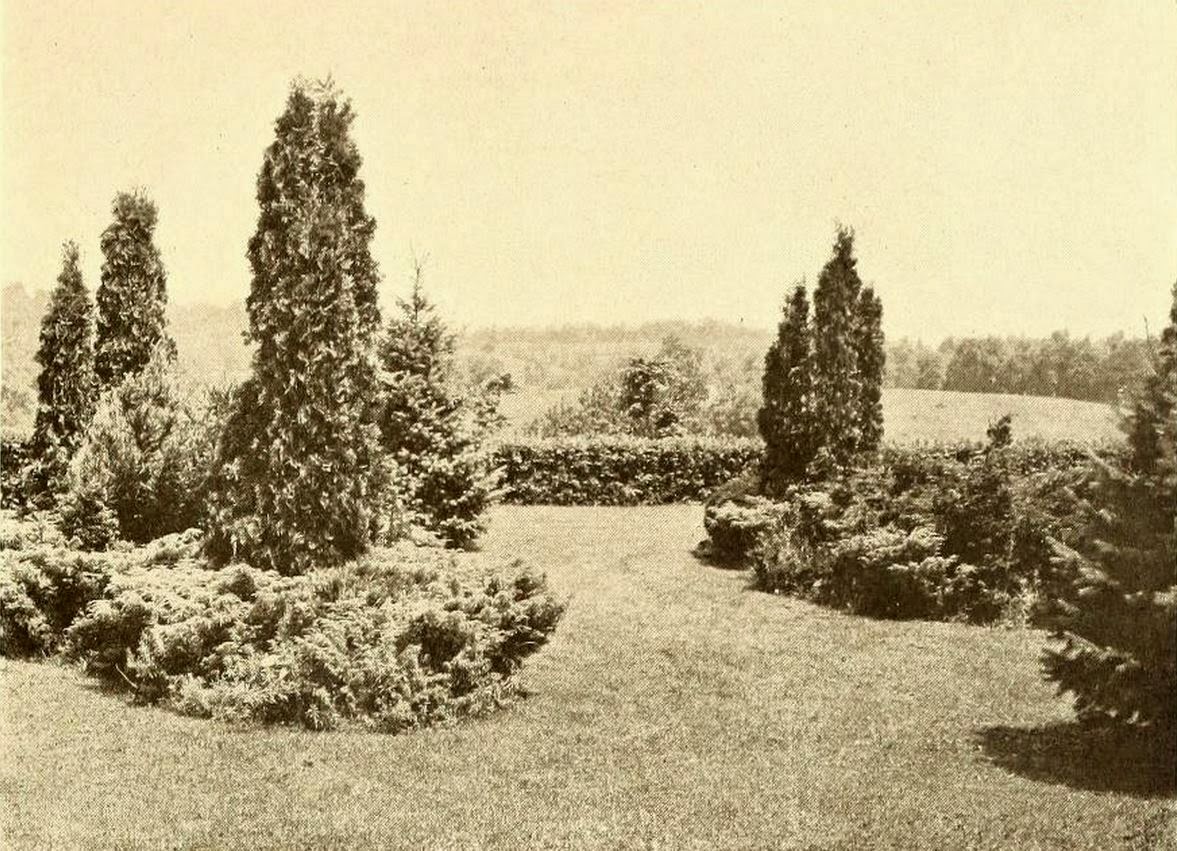
The rose garden, with arborvitae hedge, rotates box-edged rose beds in wheel design around a fountain-pool.

    Once in the rose garden, it is apparent that this was what was hidden from the driveway by the arborvitae hedge. Immediately opposite the gate are chairs, a table and gayly striped umbrella. In the center is a blue pool with pink geraniums on its edge, forming a low background for the lead child's figure which is the fountain. In four alcoves, cut into the hedge, are marble pots on pedestals about five feet high filled with fuchsias. The box-edged rose beds spread out in wheel design from the round pool in the middle. The only red roses used have been placed in two long beds against the wall, separating this from the main garden. For the rest, there are countless varieties in different shades of pink, yellow, and white, with the most profuse bloom.

One of the English lead figurines placed at intervals in the midst of the box, and white sweet-william beneath.

    At the end of one of the white pebble paths which run between the beds is an opening in the arborvitae hedge through which is reached the swimming pool, surrounded by lawn and apple trees. Beyond, down a lilac-bordered path, is the cutting garden. Protected by another hedge of arborvitae, it is on two levels, with a cold frame running the width of each terrace. On the upper terrace, brick paths divide the eight beds, in four of which are roses of different varieties from those in the garden proper. In the other beds are columbine, delphinium, and chrysanthemums. In the upper cold frame, there is some of the sweet-william used in such profusion throughout the garden, as well as pansies and johnny-jump-ups and small white clapboard tool houses, with green trim, just outside the hedge, make it possible to conceal all the necessary tools on the very edge of this lovely garden.

    Another lilac-edged walk, informally planted and merging with the lawn, leads back to the south terrace outside the house. From here, a path runs around the house to the west terrace where there are groups of iron chairs and comfortable, gaily colored outdoor furniture. Two yellow umbrellas shelter tables used for dining.


The formal herb garden, of the west terrace, has a vast variety of herb-beds traversed by paths of shredded cedar.

    At the far end of this terrace, which runs the full width of the central wing of the house, is that delight of all gourmets, a well-filled herb garden. Although easily accessible to the kitchen, it is developed as a decorative garden. Two sides are enclosed by high walls, covered with euonymus and one corner nestles happily into a corner of the house. On one side is a high hedge of box; low box surrounds each bed in the formal design, and there are occasional bushes of box and hawthorn to give height.

    To understand the quality of Mr. and Mrs. Paul's place is to know the personal interest and effort which they have put into it. This is no casually run house or garden, but a complete entity, conceived with real imagination, worked over with affection, and maintained with scrupulous care. It has that warm, rich feeling which results from its owners' lavish use of plants, paintings, furniture, and accessories. But it also has an air of tempered good taste and restraint in the handling of details. It is, indeed, a welcoming house—hospitable in the best tradition of a country gentleman.


       The interiors were a stylish setting for family antiques, sporting art, and noteworthy paintings.   When not involved in financial matters, A. J. Drexel Paul would likely be found playing polo, fox hunting or pursuing other sports.  Although the house itself had extensive damage after a fire in the late 1940's, it was preserved and remodeled, reduced in size and made more manageable for a modern style of living.

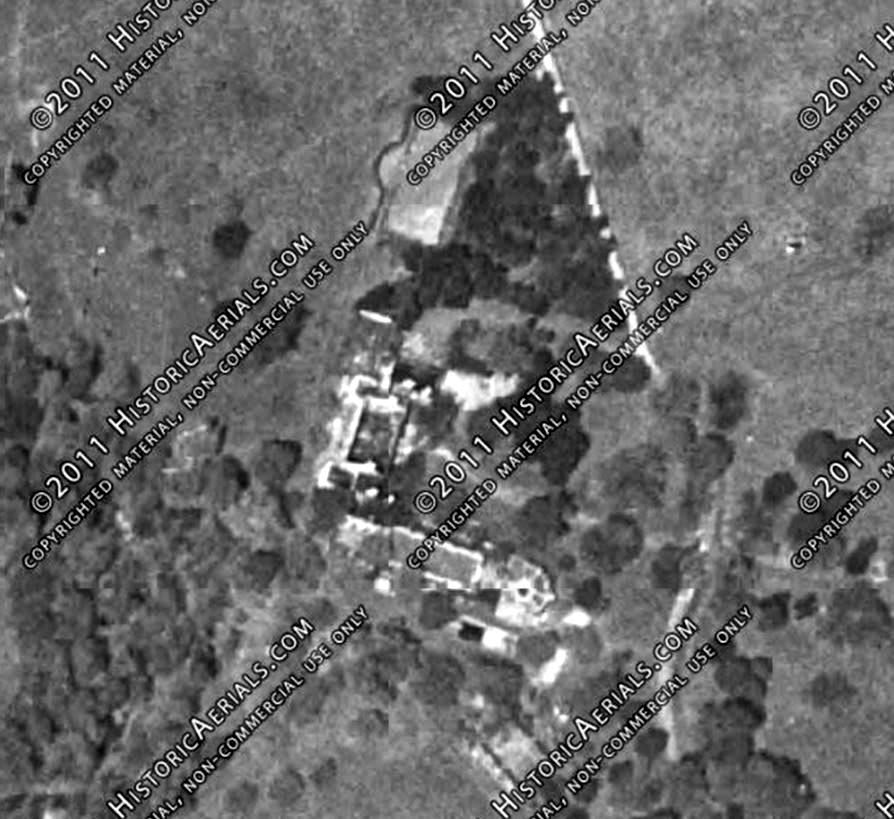
1948 aerial showing the burnt out shell. 

1950 aerial showing the altered remains
BING VIEW today.
    
    Below are renderings and photos of a project for the Paul's designed by Mellor & Meigs around the same time the Charles Platt design was built. The project is labeled "Woodcrest Farms". According to the Athenaeum of Philadelphia the house was demolished and property incorporated into the St. Davids Golf Club.  The stables and polo barn were built. I can not find anything more on the house itself.


Image Title: Garage and the House Project: Paul, Country House Near Philadelphia, PA Client: Paul, A. J. Drexel, Esq.

Image Title: First Floor Plan

Image Title: Second Floor Plan

Image Title: Barn & Polo Stable Project: Paul, Barn & Polo Stable, Radnor, PA Client: Paul, A. J. Drexel, Esq.

Image Title: Exterior: Overall: Project Paul, Barn & Polo Stable, Radnor, PA Client: Paul, A. J. Drexel, Esq.

BARN AND POLO STABLES FOR A. J. DREXEL PAUL, ESQ., RADNOR, PA.
 Mellor & Meigs, Architects
BARN AND POLO STABLES FOR A. J. DREXEL PAUL, ESQ., RADNOR, PA.
 Mellor & Meigs, Architects
    
    
Image Title: Exterior: Barn Yard: Project Paul, Barn & Polo Stable, Radnor, PA Client: Paul, A. J. Drexel, Esq.


    A. J. Drexel Paul built his own 25-room house in 1914, "down island", where most of the summer colony was located. Each summer, Isabel Biddle Paul would pack up the couple's two sons and two daughters to begin the long trek to Maine from Philadelphia.

    "We'd take a train to Bath, then a ferry across the river there, and then we'd hook up with another train, to Rockland, Maine. We'd hop on a boat - well not exactly hop - then we'd come to Islesboro, where we were met by carriage after carriage and taken to the house. We came with five or six of the help and about 10 Vuitton trunks." SOURCE

The A. J. Drexel Paul Cottage Islesboro, Maine
    

    Named for its situation at the crest of the Radnor Hills, "Woodcrest" was the estate of James W. Paul, Jr., father of Ellen Drexel Paul, born 1880, A. J. Drexel Paul, born 1884, and Mary Astor Paul, born 1889.

    Long before the Kennedy Compound in Hyannisport became so well known, there were many families with multiple large houses on their country estates, often sharing some of the service outbuildings and recreational facilities.  This was true of the Pauls at "Woodcrest".  After the death of his father in 1908, Paul and his new wife, Isabel Biddle, took possession of the acreage north of Upper Gulph Road.  SOURCE

    In 1915, both Isabel and A. J. Drexel Paul and Ellen and Paul Mills built new homes on the estate. “Box Hill” contained state of the art heating and plumbing systems. In that same year, the Mills built the Georgian Colonial “Woodcrest Lodge”, designed by Charles Barton Keene, at a cost of $40,000. Mary Paul and her new husband, Charles A. Munn occupied the large Tudor style main house. 

    It appears to have been the custom at the time in the Pauls’ social stratum to be in constant motion. Summers were spent in Newport or Narragansett Pier, Rhode Island, Dark Harbor, Maine, or in the case of Mary and Charles Munn, with his mother in Manchester, Massachusetts. Winters often found the couples in Palm Beach or Aiken, South Carolina. SOURCE

Mary Astor Paul Munn (1889-1950)
Oil on canvas, 1927. Philip de Laszlo

    Side note to Mary Munn's middle name Astor - Her fathers sister, Mary Dahlgren Paul married William Waldorf Astor and became a member of the British aristocracy.


Tuesday, April 14, 2015

"Laurento", the Estate of Craig Biddle, Esq., Wayne, Pennsylvania

"Laurento", the Estate of Craig Biddle, Esq., Wayne, Pennsylvania

"Laurento", the Estate of Craig Biddle, Esq., Wayne, Pennsylvania


http://issuu.com/acanthus_press/docs/main_line_counry_houses
 "The Italian-Renaissance styled 'Lauranto' stood atop a bluff overlooking Little Darby Creek from 1901 until the early 1980's. Designed by Peabody & Stearns, 'Lauranto' was the home of Drexel grandchild, sportsman Craig Biddle, and his wife, the former Laura Whelan.

    Following the death of their mother in 1883, four-year old Craig Biddle and his brother Livingston were raised as wards of George W. Childs Drexel. Under the terms of Anthony J. Drexel's will, each of the Biddle brothers would receive a million dollars upon reaching age 21. The lavishly decorated 'Lauranto', with 113 acres landscaped by the Olmsted Brothers, was a wedding gift to Craig Biddle from his Drexel guardians, a similar gift being made to Livingston Biddle upon his marriage.

    Lauranto's interiors were furnished largely with European purchases, including antique marble mantelpieces, classic statuary, and Aubusson tapestries from dealers in Rome and Florence. The vaulted, two-story hall, with Palladian arched windows overlooking the valley, occupied the center of the house with reception, dining, library and sitting rooms arrayed on either side.


Craig Biddle - 1918
     A champion polo and tennis player, with a penchant for lavish entertaining and investing in  Broadway musicals. Craig Biddle quickly ran through his inheritance and was compelled to sell 'Lauranto' in 1911 to banker-broker Archibald Barklie. Renamed 'Inver House', the property was sold again in 1936 to Simon Neuman, President of Publicker Industries.

    By the 1970s 'Inver House' was owned by the Roach Brothers real estate firm, which announced plans to adapt the property for use as a retirement community. This scheme came to naught, however, and 10 years later, house and stable had been replaced by a large complex of luxury town houses."


"Laurento", the Estate of Craig Biddle, Esq., Wayne, Pennsylvania


HE mansion of "Laurento" looms majestically on its hilltop, rising high and stately above the surrounding trees and shrubbery, quite dominating the landscape for many miles around. And a most agreeable landmark, it is, designed in a quiet Italian style by Messrs. Peabody & Sterns, architects, of Boston. It is a large house with spacious fronts, whose length is emphasized by the strong string-course between the first and second stories, and by the low, sloping broad roof with which it is surmounted. It is built of light-brown brick, with terra cotta trimming of a nearly white tone.


"Laurento", the Estate of Craig Biddle, Esq., Wayne, Pennsylvania 1902
Nothing remains of it now except for the gate and driveway leading nowhere.
On the top of each pillar under the lions, one can see very clearly the inscription "Inver House".

    The situation is superb, standing on the summit of a hill that rises sharply above the road by which it is usually approached, but with an ample plateau on the inner side, toward which the entrance front is faced. On the roadside the base of the hill is enclosed within a low stone wall, that presently will be thickly covered with vines. 


Roadside Watering Trough. Designed by Peabody & Stearns - wall to extreme right constructed under the Supervision of Mr. Brown with suggestions from the Olmsted Brothers. 1901
"Laurento", the Estate of Craig Biddle, Esq., Wayne, Pennsylvania

    At one point, within a recess, is a water trough for horses; farther on is the entrance, high sandstone piers capped with standing lions and supporting a wrought-iron arch carrying a central lantern: a stately, handsome entrance, as effective as it is simple.


East front from turn in approach drive at which point the house is seen for the first time on approaching. 1901


Looking North West toward approach front of house - all plants on terraces were planted spring 1902 - except privet hedge which was planted  Fall 1901.


"Laurento", the Estate of Craig Biddle, Esq., Wayne, Pennsylvania 1902
    The road within approaches the house by broad curves, for the elevation is considerable, and a somewhat lengthy detour has been necessary to accomplish an easy ascent. On the left the hillside is thickly overgrown with wild shrubbery; on the right are open fields, with the farmhouse and barn— a massive, rough cast structure—quite down in the hollow. The roadbed is fine, with young trees growing on the outer edge, and at frequent intervals are rustic posts carrying wrought-iron lanterns, square in form, and as ornamental by day as they are useful by night. Farther on, but at some distance below, the road overlooks the vegetable garden. 


The Entrance Front Is a Dignified Composition in the Italian Style
    Then the shrubbery on the left gives way to open land, and the house, which hitherto has been completely hidden, comes into view. A broad field contains a flock of sheep and the planting becomes more formal; great clumps of shrubbery are massed in beautifully kept lawns. The house has no great trees near it, those in its immediate vicinity being young. The kitchen entrance is hidden behind a fine planting of evergreens.


"Laurento", the Estate of Craig Biddle, Esq., Wayne, Pennsylvania


The Porte Cochere Is Built of Terra Cotta and Is Directly Before the Main Entrance

    A stately porte cochere, built wholly of terra cotta, is erected before the main doorway. It has four great piers, with round arches on the side, and two columns to support the entablature on the front, whence a ravishing view can be had of the magnificent lawn that stretches away from the house, and of the hilltops in the far distance.


"Laurento", the Estate of Craig Biddle, Esq., Wayne, Pennsylvania 1901


"Laurento", the Estate of Craig Biddle, Esq., Wayne, Pennsylvania
    In design this house is thoroughly distinguished. The plan may be roughly described as cruciform; that is to say, a great central body to which are applied wings, right and left. of pilasters, support the simply molded archway. The reason for the thickening of the wall is now apparent, for it gives greater depth to the arch, and transforms what might have been a purely ornamental feature into a monumental one. In the spandrils are two carved disks, which, with the monumental stairway at the base of the arch, complete the structural features of this fine centerpiece. Within, the archway has a double treatment of door and window, the doorway being in the exact center, below a broad horizontal cornice, while the window rises in majestic proportions above it, wholly filling the enclosed space.


"Laurento", the Terrace Front and Its Arch of Triumph
    The steps at the base of the arch descend upon a spacious terrace, which is built out upon the hillside, with a broader flight of central steps to the slope below. On each side of the Mobility is given to the center by slight projections: at the ends on the entrance front, in the center on the terrace front. The detailing is extraordinarily fine, very well conceived, and applied with admirable judiciousness. The large windows are sufficiently spaced, those of the first story having more elaborate frames than those of the second. The cornice at the top is high and flat, with pierced openings over the windows, and then the projecting eaves to the low roof, whose simple outline is broken only by the chimneys and the three dormers on the entrance front.


Terrace Front of "Laurento", the Estate of Craig Biddle, Esq., at Wayne, Pennsylvania
    There is more pronounced enrichment and more variety in the terrace front. On that side the center is projected far forward beyond the wings. In the center is a triumphal arch, rising high to the crowning cornice which its keystone just touches. Roman Ionic columns, with an accompanying pair center of the house are loggias which connect with the wings, each with its own steps, descending at right angles to the central flight to the great lower terrace. 


Flower garden during construction. 1901


Flower Garden and North Pergola. 1902
    The loggias are built of terra cotta, with piers and columns, and, furnished with rugs, tables, and chairs, are most delightful lounging places. The outlooks over the countryside from any of these parts are of rare beauty; immediately below is the deep valley and the road, which the house seems almost to overhang; beyond are fields of rich grass, trees and woods, hills and valleys, a lovely country outlook, perhaps nowhere so enjoyable, or so beautiful, as from the doorway beneath Mr. Biddle's arch of triumph.


"The Main Corridor Looking Toward the Billiard-room

    The entrance door leads to a small vestibule, wholly paneled in wood painted white. Its glazed doors admit to a space of similar dimensions and treated in an identical manner. This is without inner doors, but open on to the broad corridor that runs across the house from right and left. Curtains of red damask on three sides convert the center of the corridor into a sort of antechamber beyond which is the great central hall. Quite from the outer door the spacious splendor of this apartment has been visible, for the whole of the center of the house is brilliantly illuminated by the flood of light admitted by the vast window under the arch of the terrace front.


The Main Hall Is Flanked with Aisles, in One of Which Is the Fireplace with a Mantel of Carved Stone

    The hall is of regal proportions, rising to the full height of the second story. Ionic columns, on either side, divide it into three bays. It is thus basilical in plan, with aisles on each outer edge, while the central space is supported by the columns and pilastered piers in the corners. 


The Main Hall Looking Toward the Vestibule. It Is a Splendid White Apartment, Two Stories High
    Above the entablature are arches enclosing balustrades, and which surround a corridor carried around three sides of the hall at the upper story. Oriental rugs are laid on the marble floor. At the great window arch are curtains of green damask lined with white silk; at the entrance is a green curtain, and at the four doors on the sides, which lead to the other apartments, are the door and window curtains. The woodwork is mahogany, the mantel, with a facing of green marble, being of the same wood and very richly carved. The hardwood floor has a large Oriental rug, and the furniture is covered with red velvet. The white ceiling and cornice are elaborately molded and detailed. The bookcases which surround most of the lower part of the walls are of mahogany, carved and molded; they are enclosed within leaded glass doors of beautiful design. The room is lighted by side brackets. Immediately adjoining is Mr. Biddle's den, a small room in green, with green walls and green curtains over lace curtains at the single window.

    The billiard-room is at the end of the corridor, and completely fills this farthest end of the house. It is treated throughout in warm brown. The floor is formed of large dull-red bricks, on which are many small Oriental rugs. It is paneled in wood to the frieze, which is of carved leather depicting hunting scenes. The ceiling has wooden beams, corresponding with the rest of the woodwork, the panels being filled with leather, of the same beautiful warm-brown hue which characterizes the whole room. The curtains, both for tapestry curtains of blue and yellow tones. On the left, within the aisle, is a handsomely carved fireplace and mantel of white stone; on the opposite wall, in the aisle, is a superb piece of tapestry. In the center is a green marble table with white marble feet: it supports a richly carved vase. In the corners by the entrance are marble statues.

    The rooms on either side may be reached from the central hall, but it will perhaps be more convenient to visit them from the main corridor. Like the hall and vestibules this is floored with white marble, spread with rich Oriental rugs. On the right it leads to the billiard-room, situated at the extreme end of the house; and on the left it connects with the servants' quarters. It is so broad, and high, and spacious—as are all the apartments on this floor—that it has a true monumental character. Its chief decoration is a series of busts of Roman emperors, of which six are in the right hall, while two stand in the farther corners of the left extension. These sculptures are nobly placed, and add immensely to the monumental effect of the corridor.

The Library Is Finished in Mahogany with Walls of Red Brocade
    The first room on the right is the library; it is also directly entered from the great hall. The walls are covered with red striped damask, the same rich material being used also for the doors and the windows, are of brown leather with green and gold bands. The spacious mantel is of wood and is a part of the wainscot. The facings are of red brick similar to the floor; immediately above, in the center, is a large deer's head. The windows have white lace curtains within the leather curtains. At either end is a low platform with a builtin seat. The furniture is covered with light-brown leather. The great height of the ceiling adds immensely to the effect of this beautiful room.

The Reception-room, with Paneled Wails of French Gray, Is Louis XVI in Style
    The reception-room is opposite the library and faces the entrance front of the house. It is designed and furnished in the Louis XVI style and is a delightfully cool and charming apartment. The paneled walls are in French gray. There is a built-in mirror over the fireplace, which has facings of mottled-red marble. The curtains are of pink damask over white. The chairs are of French gray covered with tapestry, and the other furniture includes many fine old pieces of great beauty.

    On the left hand side of the entrance doorway are two rooms, both entered from the main corridor. That on the front of the house is the breakfast-room, treated wholly in yellow, with warm-yellow walls, and curtains of the same brilliant color. 


An Immense Slab of Green Marble Encloses the Fireplace of the Dining-room

The Dining-room Is Paneled in Dark Oak, Above Which Is a Frieze of Old Tapestry
DINING-ROOM
"Laurento", the Estate of Craig Biddle, Esq., Wayne, Pennsylvania
    The dining-room is opposite, and is one of the most sumptuous apartments in the house. The walls are paneled in dark oak to the broad tapestry frieze, a fine old piece of unusual beauty. The ceiling is cream color with decorated beams forming small square panels. The woodwork of the doors is enriched with carving, and there are elaborately carved tympanums in the arched doorways on the side. The fireplace is encased within a huge slab of mottled-green marble, to which a shelf of the same rich material is applied. The sideboard, on the opposite side of the room, is built in, and is designed in harmony with the decorative woodwork of the doors and mantel. The hardwood floor is covered with a green rug, and the curtains are of green velvet with gold braid bands. The oak furniture is very elaborately carved. The room is lighted by gilt sidelights applied to the panels of the walls.

The Massing of Foliage Plants and Trees Is Admirable
    One end of the house, the nearest end as it is approached by the entrance driveway, is wholly given up to the service. The planting here, as has been stated, consists of evergreens, arranged in picturesque masses. 


Looking down on flower (Italian) garden from a second story window of house. 1901
View of Long Terrace and Flower Garden. 1902
The Formal Garden of "Laurento" with Its Central Fountain and Encircling Flower Beds
    At the farther end is a small formal garden, the chief ornament of which is a marble fountain, placed exactly in the center, and formed of a charming group of children playing in a small marble basin. Concentric beds of circular segments are planted around the fountain, until the corners are filled out in squares. The planting is chiefly annuals, arranged in brilliant masses of color. The whole is enclosed within a hedge. At the farther extremity beyond the fountain the land dips suddenly, but the ravine is partly screened by the garden hedge. Beyond are hills, with trees and woods, a beautiful outlook over the many beautiful spots within and without the estate grounds.


Looking South East from Italian garden towards the Stable. All plants seen in photo except the trees in background were planted either Fall 1901 or Spring 1902.

Path south of the esplanade and looking east toward stable. All planting put in Spring 1902.

The Stable and Clock Tower - East front.
The Stable and Clock Tower - East front.


Welcome to Inveraray

INVER HOUSE GREEN PLAID
    Follow THIS LINK to see an aerial view from 1948 showing the estate standing.


September 19, 1908
Mr. Oelrichs said I never saw anything or anybody that came from Philadelphia that was any good and I can back up my words if you will step outside. Biddle was reported to have had his face smacked by Harry Oelrichs.


    "Harry Oelrichs was one of the most intimate friends of James Gordon Bennett," writes Edward Vizetelly in a London weekly. "Between them they introduced polo into America, and were familiar figures, side by side, in Broadway years ago, particularly after dark." SOURCE