"The appropriation for a house should be divided into two equal parts, one-half for the house, the other for the gardens, pathways, court, approach, terrace and the rest of it, or, as it might be termed, one-half for the pudding, the other for the sauce." Architect Thomas Hastings
Showing posts with label Carrere and Hastings. Show all posts
Showing posts with label Carrere and Hastings. Show all posts
William Boyce Thompson was born May 13, 1869, in Alder Gulch, Virginia City, Montana. He would later use the name of his birthplace for his new, grand home in Yonkers. His early years were typical of mining towns of that generation. In 1887, at 18, he was sent east to the Phillips Exeter Academy, and upon completion of his studies there enrolled in the Columbia University School of Mines. He later returned to Montana, and was employed by his father in the family's copper and silver mines in Montana and Arizona. On February 6, 1895, he married Gertrude Hickman in Butte. Encouraged by success, the couple relocated to New York where he joined the Curb Exchange. Exeter classmates and club members soon introduced him to influential New Yorkers. As he was one of the few people on Wall Street with a comprehensive knowledge of the mining business, he became a successful mining promoter and developed mining properties in Canada and the west and southwest of the U.S. Later he acquired diamond mines in Africa. The Guggenheim Brothers, J.P. Morgan and Bernard Baruch were his sometime business partners. He made an astounding fortune. Through a series of land purchases from 1906—1910, he began to acquire properties in Northwest Yonkers. Around 1910 he commissioned the architectural firm of Carrere and Hastings to draw up the plans for his magnificent estate, which he called "Alder Manor". The Colonel title was bestowed upon Thompson when he led a Red Cross Commission to Russia after WWI to determine the need for medical supplies and other relief.
wikimapia location. BING. Follow THIS LINK for an insiders tour from John Foreman's Big Old Houses. John Polachek was a Hungarian immigrant making ornamental bronze and iron in Long Island City, L. I. His work was so revered that orders came from banks, theatres and public buildings. Architects as far away as Montreal, Tokyo and Buenos Aires commissioned him to reproduce their designs. Polachek played a part in the consolidation of eleven American foundries, including Tiffany Studios Bronze & Iron Plant, into the General Bronze Corporation.
This garden, which has the atmosphere of an English Manor garden, is on the estate of Bradley Martin, Esq., at Old Westbury, L. I. Landscape Planting by Lewis & Valentine Company
Follow THIS LINK to view all past posts related to "Knole".
MRS. RICHARD GAMBRILL'S chateau on Bellevue Avenue is one of the rarely beautiful homes of Newport. Set in the midst of superb gardens whose hedge-bordered lawns slope toward the avenue, the house composes perfectly with its surroundings. The windows of every room afford enchanting glimpses of gardens, of pergolas where tea is served on those afternoons when the chatelaine is not "teaing" somewhere else; of terraces where coffee is served under the rays of the moon, or of soft-toned electric lights. The interior of the house is well worthy of its surroundings. Although marble is used very extensively, there is no atmosphere of coldness nor of a too great formality. The entrance hall is almost austere in its treatment, but its charm of outline and the color note given by the tapestries counteract the effect of the marble walls and pillars.
The dining-room is a ceremonious apartment overlooking the red garden. The tones of the geraniums, the salvias and the rambler roses are repeated in the hangings and the rug of this gracious room. Of unusual interest are the two side tables of marble which take the place of the more conventional sideboard. The lighting fixtures are exquisitely beautiful. Mrs. Gambrill, in fact, has a penchant for beautiful fixtures; and those in every room are an artistic joy. Over one of the marble side tables hangs a portrait by Sir Peter Lely.
The drawing-room is truly regal in coloring and treatment, but with all its splendor it is thoroughly livable. The walls of French walnut are a delightful background for the paintings which incidentally are used but sparingly, for this is truly a summer home, not a "winter palace". This room is delightful and as a "period room" it is practically perfect. The long windows open toward the terrace, which overlooks the sunken garden and fountain.
The flower room or little salon is a study in the softest tones of gray, du Barry rose and green, just the colors that predominate in the gardens without. The gray tone is given to the garden by the profuse use, in its borders, of dusty miller, which blends with the various shades of pink and rose from which these gardens take their name. Click THIS LINK for more on the Newport residence of Mrs. Richard Gambrill. THIS LINK to view a post from the man with the golden key.
The classic fountain, designed by Carrere and Hastings for the Plaza Hotel at Fifty-ninth street and Fifth Avenue, New York City, is the gift of the late Joseph Pulitzer. The structure is now completed with the exception of the figure which surmounts the fountain. This figure, which was modelled by the late Karl Bitter, will be cast and put in place this month.
In the foreground of the drawing may be seen the Saint Gaudens' statue of Sherman, which is to be the centre of a duplicate plan to be developed at the entrance of Central Park on the north side of Fifty-ninth street. The Plaza Hotel is on the right. In the background is the home of Mrs. Cornelius Vanderbilt.
THIS is at Morristown, New Jersey. It belongs to Mr. Kahn.
"CEDAR COURT" PLOT PLAN
Cedar Court, panoramic view of house, ca. 1900
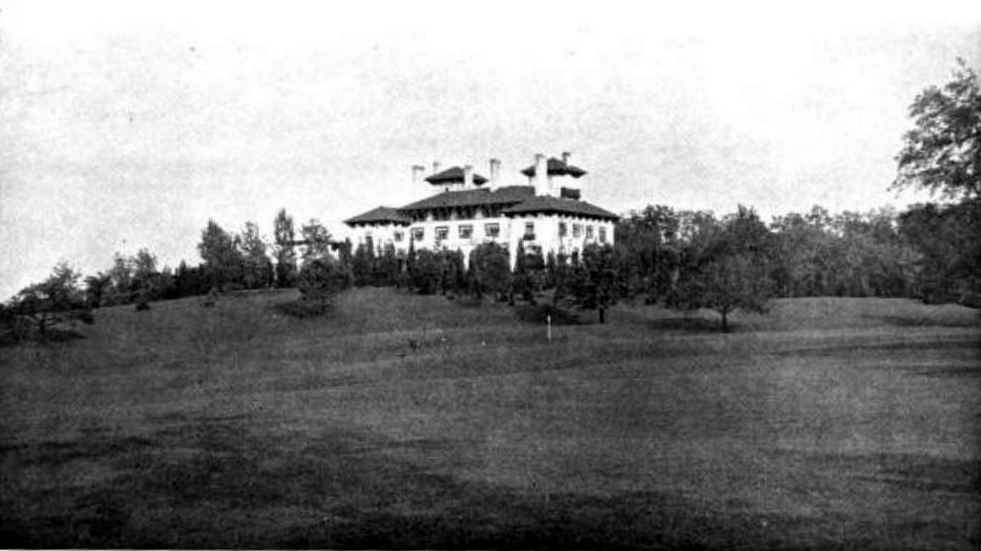
A DISTANT VIEW OF "CEDAR COURT" FROM THE GOLF COURSE TO THE NORTH
The house was built about ten years ago by Carrere and Hastings, and the grounds were laid out by them also. The house is good Italian in style, with red tile roof and white plaster walls. It occupies the top of a hill, the land sloping away on all sides, and is surrounded by a rich rolling country.
Cedar Court, panoramic view of entrance from Columbia turnpike, ca. 1900
Cedar Court, entrance from Columbia turnpike, ca. 1910
One enters the place through two entrances. There are lodges at each of them. The west approach is a winding one, not of great length, and of secondary importance.
THE ENTRANCE AND LODGE
WINDING MILE-LONG ENTRANCE DRIVE
Cedar Court, the driveway, ca. 1900
The south one is the principal one, and is first through a short straight avenue of maples, then by a long winding drive of about half a mile in length, through a grove, and then up to the house by a rather steep grade.
The exteriors of these two houses at Morristown, N. J., which were built for two sisters, are identical The two fine native cedars in the foreground, which were found at the place, were made the keynote of the entire composition. The axis of the court centers between them.
The two dwellings form two sides of the court, the pergola the third side. The fourth side, through which the houses are approached, is treated with a balustrade.
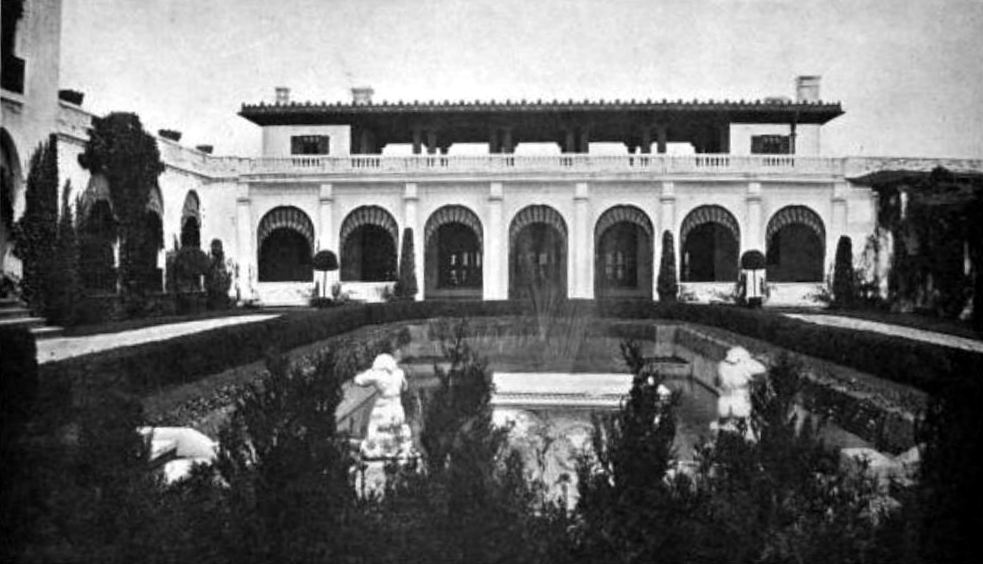
The entrance-court is an exceedingly pretty one. It is about 125 by 100 feet. It is enclosed on the entrance side by a stone balustrade. Two cedar trees mark its entrance(the two cedar trees for which the estate was named), with a portion of the house, the sun parlors, opposite.
Cedar Court, newly constructed front entrance, ca. 1900
Cedar Court, front entrance and fountain, ca. 1915
Cedar Court, view from terrace looking east, ca. 1915
The house is on one side of the court and a pergola on the other side. An oblong marble basin is in the middle, with a fountain at each end of it. It is out lined with a low box hedge and grass border. The pergola is prettily covered with wisteria.
THE ENTRANCE-COURT AND ENTRANCE TO THE HOUSE FROM THE SOUTH
COURTYARD VIEW
ANOTHER VIEW
THE SUNKEN GARDEN ON THE EAST
ANOTHER VIEW
On the north side of the house is a croquet court, and on the northeast a sunken garden, and on the east side of it is a terrace of grass and a high retaining wall on the outside. The service entrance is on the west side and completely hidden by trees and shrubs.
THE ROSE GARDEN AND AND THE SQUASH BALL HOUSE
Cedar Court, rose garden, ca 1910
Cedar Court, tennis court, ca 1900
To the south, at a short distance beyond the pergola, is a rose garden, and near by that a tennis court. A little farther on is a building for squash ball. The stables are to the west of the house, about one thousand feet from it, and well hidden.
Cedar Court, pond designed by John Brinley, ca 1915
Cedar Court, pond designed by John Brinley, ca 1915
DUCKS ON A POND AT "CEDAR COURT"
A pond with aquatic plants and swans upon it is in the lawn at the foot of the hill, to the north of the house. To the west and north a golf course stretches away over many acres of lawn and park.
View of Kahn Estate, circa 1900.
It is a very attractive place, and one of the most successful of the modern ones. It shows how effectively some of the most beautiful features of the Italian villas may be adapted to our needs and conditions, it also shows, particularly in its tennis courts, golf course, squash court, etc., what might be termed typical american work.
The property sprawled over 176 lush, level acres, 136 of which had been tamed and trimmed into luxuriant gardens and grounds while the remaining 40 acres were farmland.
Otto H. Kahn (1867-1934) came to America in 1893 to work for the New York Investment bank of Kuhn, Loeb & Company and became a colossus of finance before World War I. He was one of the country's most important patrons of opera, drama, and fine art. He made a considerable fortune, augmented by his wife's family wealth. His house at Morristown was the first of several expensive residences.
The twin villa's of "Cedar Court"
Cedar Court, view from pond
"Cedar Court" was commissioned by Abraham Wolff as a residence for his daughter and son in-law. During its construction, Wolff's daughter Clara married Henri Wertheim of Holland, and Wolff commissioned a second villa, identical to the Kahns' house, to be built at a right angle to the first dwelling overlooking a shared garden terrace. Mrs. Henri Wertheim died during childbirth in 1902.
Cedar Court, adjacent mansions before 1905 fire, view from pond
Cedar Court, altered photograph showing only one of the adjacent houses
The main building was an Italianate mansion of magnificent proportions. The living space in the residence, including a wing connected to it by a glorious glass-enclosed pagoda, totaled forty rooms.
During this time the Kahn's took over the entire property, moving into the remaining villa.
THE FOUNTAIN AND BASIN FROM THE NORTH
THE SAME FROM THE OPPOSITE DIRECTION, THE PERGOLA ON THE LEFT
They added a ballroom addition where their old home once stood. The 1,100-acre site in the Normandy Heights section of Morristown was at the time one of the most elaborate properties in an area known for its millionaires.
"CEDAR COURT"
The double-tower design of both houses was derived from the Villa Medici in Rome but also bore a resemblance to the Alcazar Hotel in St. Augustine, Florida, another Carrere & Hastings design. The over stuffed stucco structures with red-tile roofs seem somewhat out of place in the New Jersey countryside.
"CEDAR COURT" - FOUNTAIN AND DRIVEWAY
Kahn's impressive art collection included a Frans Hals, a Rembrandt, and George Romney's "The Three Children of Captain Little" Otto Kahn's lifestyle was grand and always theatrical - one party for his daughter Maud included performances by tenor Enrico Caruso, ballerina Anna Pavlova and French music hall performer Yvette Guilbert. An elegant dresser with a courtly demeanor, Kahn ran "Cedar Court" in the manner of European aristocratic families, with formal meals and a large retinue of servants. He spared no expense on stylish settings and gifts for his family, and he spent lavishly on the house and grounds. Yet Kahn was only marginally accepted in the social circles of Morristown and the Somerset Hills and could not break into such caste-protective enclaves as the Morris County Golf and Country Club, where he was blackballed after seeking membership. Although he contributed much to the area, in 1920 Kahn and his family decamped for "Oheka", their vast Delano & Aldrich designed estate at Cold Spring Harbor, Long Island.
The estate had cost Kahn over a million dollars; he would sell it for $250,000. Mr. Kahn had employed between fifteen and twenty-two men year-round just to maintain the grounds.
View of front entrance and gardens during the time of The Physiatric Institute - 1920
Kahn sold his estate to Dr. Frederick Allen. Carrere & Hastings returned to "Cedar Court" in 1922 to undertake alterations for its conversion to the Psychiatric Institute, a medical treatment center.Dr. Allen helped introduce insulin for the treatment of diabetes. Because the property had been vacant and deteriorating for several years, there were repairs to consider, and the nine hot-air furnaces would have to be replaced with central steam heat before the first winter. The project was not successful; however, several years later after Mr. Kahn’s death, the Kahn family decided to raze “Cedar Court” to save taxes.
The property lay idle for more than a decade, untilAllied Chemical Corporation(Honeywell) purchased the estate in 1942 for $32,500.
By 1948 a laboratory built on the hilltop where “Cedar Court” had stoodwas ready for its staff of 150 scientists. Click HERE to see a 1931 aerial showing the estate still extant. Ongoing disputes with a planed redevelopment of the property and the recent announcement of the company's movefrom the area have riled local activists.
Cedar Court, front entrance way, ca. 1910
Cedar Court, Entrance Hall, ca. 1900
Cedar Court, Entrance Hall, ca. 1900
Cedar Court, hall and living room, ca. 1900
Cedar Court, reception room, ca. 1915
Cedar Court, formal living room, ca. 1900
Cedar Court, dining room, ca. 1900
Cedar Court, dining room, ca. 1900
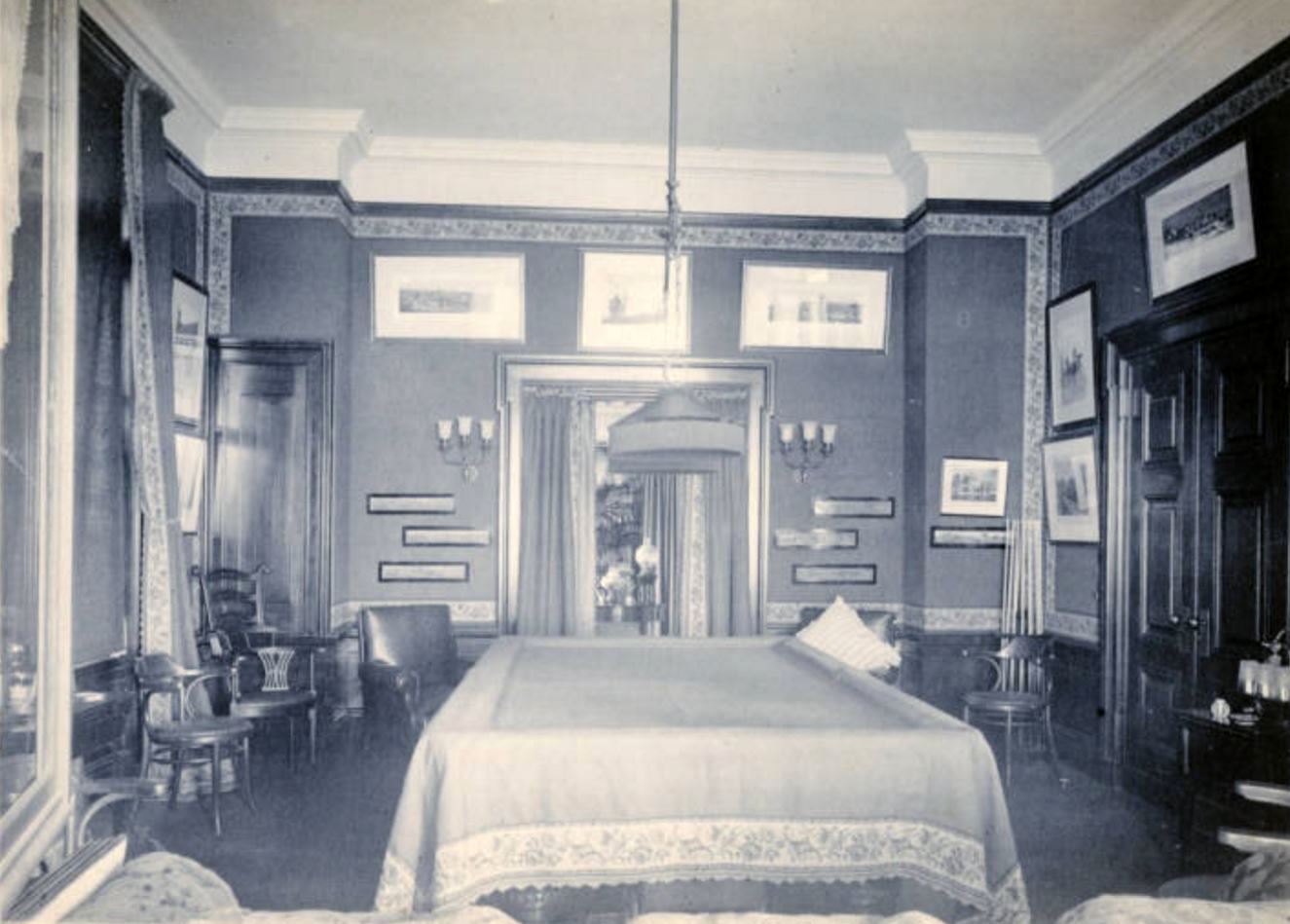
Cedar Court, billiards room, ca. 1900
Cedar Court, upstairs hall , ca. 1900
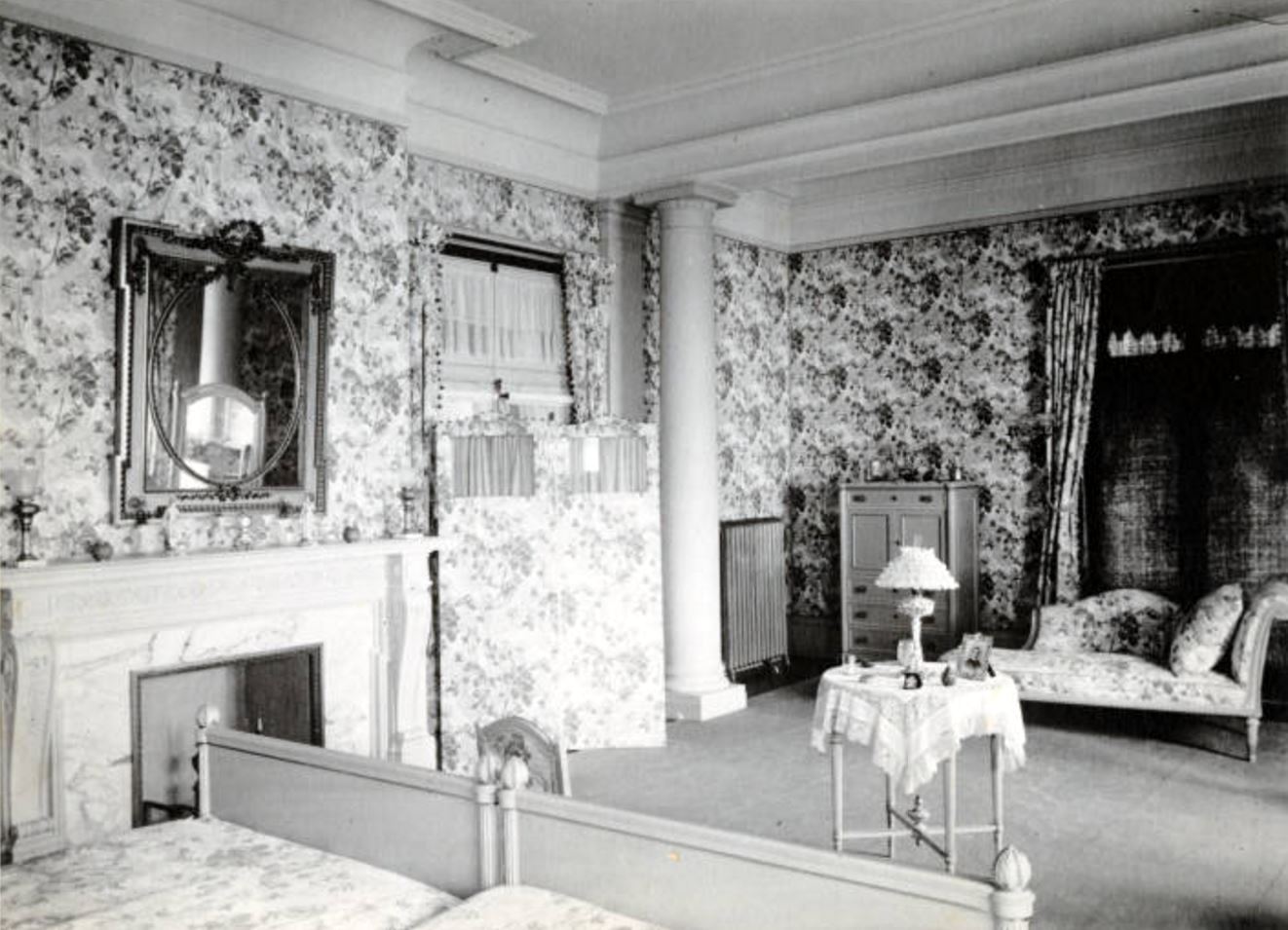
Cedar Court, bedroom, ca. 1900
Cedar Court, bedroom, ca. 1900
Cedar Court, bedroom, ca. 1900
Cedar Court, guest bedroom, ca. 1900
Cedar Court, bedroom, ca. 1900
Cedar Court, guest bedroom, ca. 1900
Cedar Court, terrace looking east, ca. 1915
Cedar Court, view from terrace looking east, ca. 1900
THE FOUNTAIN AND BASIN LOOKING SOUTH
THE FOUNTAIN AND BASIN IN FULL FORCE
THE FOUNTAIN AND BASIN FROM THE NORTH
View of the pergola which closes one side of the carriage-court at "Cedar Court", Morristown, N.J., designed by Messrs. Carrere & Hastings.
The columns are of light-colored stone and the superstructure is of wood painted almost black to give a strong contrast.
VIEW THROUGH THE PERGOLA
THE EAST TERRACE AND THE PLAZA STAIRWAYS
Cedar Court, formal gardens looking east from terrace, ca. 1915
VIEW FROM TERRACE
Cedar Court, view from garden, ca. 1900
Farm group and gate house remain. Click HERE to see at wikimapia.
ENTRANCE TO FARM BUILDINGS
Cedar Court, superintendent's house, Columbia road entrance, ca. 1915


.png)