 |
| HOUSE OF R. R. CONKLIN HUNTINGTON N. Y. WILSON EYRE, ARCHITECT |

"The appropriation for a house should be divided into two equal parts, one-half for the house, the other for the gardens, pathways, court, approach, terrace and the rest of it, or, as it might be termed, one-half for the pudding, the other for the sauce." Architect Thomas Hastings
Showing posts with label Huntington. Show all posts
Showing posts with label Huntington. Show all posts
Friday, October 4, 2013
House & Garden for Roland R. Conklin, Esq, Huntington, L. I.


Thursday, April 11, 2013
Rosemary Farm Theater - Stages on the Sound - April 26-28, 2013
ROSEMARY FARM OPEN-AIR AMPHITHEATER
by

April 26-28, 2013
At Rosemary Farm on the grounds of the Seminary of the Immaculate Conception
440 West Neck Road
Huntington, NY
The former Conklin owned/Olmstead designed outdoor showplace that inspired us to start a theatre company is back under our care!!!!! Those of you that were around years ago when we cleared away ages of neglect and saw this magical space can appreciate our excitement. The Stages family will be getting our hands dirty once again to prepare the stage and grounds for some exciting upcoming projects (more on that later). We need hands to help us and hope you will lend us a pair or two.
We will be mowing, weeding, chopping, sawing, sweating, eating and laughing.
Rakes and shovels will be provided but if you are handy and have lawn tools feel free to bring them along. Housing is available so we need an RSVP if you need a room for the night. Through the generosity of the seminary we have free basic rooms with showers available on site for a limited number of out-of-town workers.
Hot breakfast is provided on Saturday and Sunday and we will be cooking out at some point if the weather permits.
You are welcome to arrive on Friday evening and stay through Sunday but work officially begins on Saturday morning.
If you are arriving by train please let us know so that we can try and arrange a ride for you.
RSVP at stagesonthesound@gmail.com
Or friend us on Facebook.

Click HERE to read about the preparations for a late summer play at the Amphitheater from 1916.
by
Thanks to AmySB

April 26-28, 2013
At Rosemary Farm on the grounds of the Seminary of the Immaculate Conception
440 West Neck Road
Huntington, NY
The former Conklin owned/Olmstead designed outdoor showplace that inspired us to start a theatre company is back under our care!!!!! Those of you that were around years ago when we cleared away ages of neglect and saw this magical space can appreciate our excitement. The Stages family will be getting our hands dirty once again to prepare the stage and grounds for some exciting upcoming projects (more on that later). We need hands to help us and hope you will lend us a pair or two.
We will be mowing, weeding, chopping, sawing, sweating, eating and laughing.
Rakes and shovels will be provided but if you are handy and have lawn tools feel free to bring them along. Housing is available so we need an RSVP if you need a room for the night. Through the generosity of the seminary we have free basic rooms with showers available on site for a limited number of out-of-town workers.
Hot breakfast is provided on Saturday and Sunday and we will be cooking out at some point if the weather permits.
You are welcome to arrive on Friday evening and stay through Sunday but work officially begins on Saturday morning.
If you are arriving by train please let us know so that we can try and arrange a ride for you.
RSVP at stagesonthesound@gmail.com
Or friend us on Facebook.

Click HERE to read about the preparations for a late summer play at the Amphitheater from 1916.
Thursday, January 3, 2013
GREEK DRAMA AND FRENCH MUSIC IN NATURE'S LOVELIEST THEATER
Background music in memory of Patti Page - Clara Ann Fowler November 8, 1927 - January 1, 2013) - "Old Cape Cod"
 |
| ROSEMARY COTTAGE on the Conklin estate at Huntington, Long Island, where Mr. and Mrs. William Faversham are planning the production of "Orestes" in Mr. Conklin's beautiful open-air theater: |
GREEK DRAMA AND FRENCH MUSIC IN NATURE'S LOVELIEST THEATER : BY MARY
FANTON ROBERTS
 T was just at twilight that we climbed the stone stairway to the hilltop, passing great jars of rose-colored bloom and merging through a vast stone arch to the edge of a sunken garden that seemed a succession of beautiful flowering terraces and that held the eye for a moment before it rested on a blue lagoon and then over formal clusters of trees out to the wide blue sea. It was like a vision of some fair old, old Latin garden with the rich-flowering cup-shaped hill ending in the line of blue, the deep foliage at the right, the two slender figures of Hermes guarding the bridge which crosses the lagoon from the hillside to the stretch of green turf.
Mrs. Faversham and I sat down on the edge of the top terrace that circled the great amphitheater and slowly, through the dusk, I began to realize that this lovely green cup on the top rim of which we were resting was the amphitheater of which so much has been written—the outdoor Greek theater on the estate of Mr. Roland B. Conklin at Huntington, Long Island. I have been studying outdoor theaters for a number of years and had heard a great deal about the beauty and wonder of this place; but I realized there in the twilight as I looked down from terrace to terrace, over one flowered wall to another, down until the blue lagoon cut my line of vision from the green stage beyond them that I have never seen or imagined such a beautiful outdoor theater as Mr. and Mrs. Conklin have just completed, and which will be opened in September by Mr. William Faversham in Richard Le Gallienne's presentation of "Orestes," especially made for Mr. Faversham's performance.
Before my twilight glimpse of the green amphitheater, I had asked Mr. Conklin just how he had developed this outdoor theater plan and he said, "It means three summers' vacations." For it has taken all summer long for three years to design and create and complete this beautiful place of entertainment.
Some years ago it seems that Mr. and Mrs. Conklin, while traveling in Europe, were very much interested in the fine old Greek and Roman amphitheaters and especially delighted with the one at Warsaw, Poland. Indeed, the only really suggested inspiration for this beauty spot on the Conklin estate is the Warsaw theater, so much so that when Mr. Ordynski visited it a few weeks ago he said at first, "It is wonderful, unique!" And then after standing silent and looking over the terrace to the sea for some minutes, he said, "Somehow it reminds me of the theater at Warsaw."
As I talked with Mrs. Faversham about the beauty of the theater, she said, "It is very hard to imagine how much hard work and how much expense is hidden under all this green, back of the stones and wall flowers, for every terrace is supported by a stone structure and where the front wall of each terrace is revealed seventy-nine varieties of wall flowers have been planted. In addition to this one hundred varieties of wall flowers have been brought over from Switzerland in seed packages to be planted and tested and eventually added to the American collection when proved worthy and beautiful enough. One of the wonders of this amphitheater to me is the fact that it will grow more beautiful every year. I can see the time when all the stone walls below the terraces will be gorgeous tapestries with lovely outline patterns in green vines running through. Of a more beautiful place to present a Greek play with rich and rare music we have never dreamed." And so it seemed to me.
 |
| AMPHITHEATER OF THE "NATURAL" OUTDOOR THEATER built by Mr. Roland Conklin on his estate at Huntington, Long Island, at an expense of forty thousand dollars: The rock support of each terrace is half hidden under wall flowers: Beyond the trees one can get a glimpse of the sea and at the right of the picture just an edge of the green turf stage. |
LATER, the sun dropped away entirely, leaving just a pale rose canopy over the stage of the theater, and I could imagine there, Orestes' return to his own land, Clytemnestra's terrific arraignment of her husband, Electra's appeal to her brother that the father's honor should be vindicated, Cassandra's appearance in the magnificent train of Agamemnon, no longer a priestess, only a woman heartbroken and prophesying her own death. I could picture figures moving in and out of the green grove beyond, Orestes at last going mad with the tragedy that fate had forced upon him. I could see, too, the Greek dancers on the green turf with the gray Hermes regarding them gravely. And then I could imagine the wonderful curtain of water which will be used to hide the stage from time to time, which will rise up out of the blue lagoon a solid sheet, a thousand shades and tones from the lights that will be thrown over from the hill above. And then through the woods and over the lagoon I could hear the strains of Massenet's tormentingly beautiful music, the music that will fill the air as Cassandra kneels in desperation before Apollo, the music that will go softly out to the audience as Orestes mourns over his fate, the music that melts through the shadows as Clytemnestra declares her love for the new king and her never-ending revenge for the death of Iphigenia.
 |
| STAGE OF THE OUTDOOR THEATER on Mr. Conklin's estate, showing the rock foundation, the grove at the back, the bridge over which actors pass and the blue lagoon which flows in from the sea and from which the unique water curtain will rise between the acts of the ancient Greek play. |
And Mrs. Faversham told me, as we sat there with perfume and night bird calls all about us, that they are to have the great good fortune of an orchestra of seventy-five pieces from the New York Symphony, directed by that rare musical spirit, David Mannes. Mr. Mannes is spending the summer with his family at one of the cottages on the Conklin estate, and many evenings are spent at the Faversham's house, a lovely centuries-old place called Rosemary Cottage, where scenes of the play are worked out together, with the music and the various actors and artists.
 |
| Front view of the centuries-old cottage, hardly visible through the canopy of blossoming wild roses. |
The evening after our twilight vision of the play in the beautiful amphitheater, Mr. Faversham showed us something of his plan for the first act of "Orestes," playing for us each character with miraculous beauty and understanding. Then, from time to time, the music would flow out under his words, melt into his voice and we would feel for the moment, through the magic of one man's voice and genius, as though we were really out on the green hillside seeing the whole beauty of "Orestes."
 |
| Wild roses in bloom over the porch at Rosemary Cottage. |
These evenings at Rosemary Cottage, with the smell of the sweet brier blowing in the low casement windows and the tang of the salt air coming to us as the wind freshened, are such rare evenings as one likes to picture, where groups of people, vitally interested, loving beauty, understanding art and willing to give their time, their energy, the very things that are a part of their capacity for living, to gather together something of rare significance for the happiness of the people who see it and for the benefit of a much needed American charity. It is so one likes to think of art, producing beauty and giving good gifts to the world and it is not always so that one can view art in this country because, unfortunately, America has made art a luxury. We count beauty for the rich, as we do jewels and champagne and comfort, and the spectacle of a group of people all eager to produce the greatest beauty they know for the sake of artis a rare spectacle, and one that cannot be too widely recognized.
AMERICA is bound to be interested in the people who are going to work with Mr. Faversham and Mr. Mannes for Mr. Le Gallienne's play, "Orestes." To begin with, of course, we shall have Mr. Faversham as Orestes, Julie Opp as Cassandra—and a magnificent figure we can imagine her in the rich robes of the conquered priestess with the tragic Massenet music, Miss Julia Arthur has offered her services for Clytemnestra, and there is a whisper that Phyllis Terry will add her fine Saxon beauty as Electra. Also we have been told just as we are going to press that Nijinski is to dance in the Greek dances. Surely this will add such beauty to the perfumed, verdant amphitheater as will provide the treat of a century to lovers of art.
Already groups of people are getting together to plan costumes and to rehearse the various parts that the production of the play shall and to rehearse the various parts that the production of the play shall be as perfect as the opportunity for its presentation. I understand that there will be no scenery as such, only beautiful costumes appropriate to the time (meaning Greece) and to the place (meaning Huntington), with much white as the Greek play demands and much color as today we are asking for in our outdoor theater productions.
Perhaps one of the most interesting things in connection with this production of "Orestes" is the community spirit that has been developed; and that makes one realize how little community spirit there is in the average large city. Here is a small group of people, artists and lovers of what is valuable, and instantly the purpose develops that puts before the world something that would otherwise have been missed. We find Mr. Le Gallienne offering his play gladly without a hint of what should be returned to him, we find Mr. Kennerley, who is the publisher of the play, offering the presentation of it, Mr. Conklin facing the immense difficulty of adjusting the seating arrangements, the wonderful curtain and various plans for the comfortable housing of the orchestra, the plan for rehearsals, the light equipment, which will be extremely beautiful and quite unique in effect, and then the artists themselves all eager to contribute, that one supreme thing maybe presented.
THIS is really the opening of the theater, although we understand that the quality of the situation was tested out some years ago by those good friends of The Craftsman, the Coburn Players. "As You Like It" was presented there from the stage as it stands today, but without the terrace, the lagoon, the bridge, the curtain of water and the formal stage planting; so that we really have the first production of the play, the opening of the loveliest outdoor amphitheater in America, and a group of artists and musicians such as one seldom finds congregated in even the most elaborate of metropolitan performances. The proceeds of the play have already been arranged to be given to the most popular charity in America today, the families of the guardsmen who are at present on the Mexican frontier. A group of Long Island society women are in charge of the sale of seats and vastly interested in the production as a means of accomplishing both beauty and good.
There will be two performances of "Orestes," one in the afternoon and one in the evening of September sixteenth, and it is hard to decide which will be the more alluring of the two, the one under the brilliant blue sky (for, of course, we are taking it for granted that it will not rain), with all the flowers gaily strewn over the amphitheater and a far glimpse of the sea, or the night performance with the extraordinarily interesting scheme of lighting, with the deep green stage and woods beyond, the mystery of the dark lagoon and the shining water curtain hemmed in by shadows.
 |
| WILLIAM FAVERSHAM AS "MARK ANTHONY:" Mr. Faversham has entire charge of the production of "Orestes" at the outdoor Conklin theater: The music for this production will be under the management of Mr. David Mannes, who is at present living at Huntington, and working daily with Mr. Faversham for the perfection of the presentation of the Massenet music. |
Although Mr. Faversham is planning an important production himself in New York this fall, Bernard Shaw's delightful comedy. "Getting Married," he is practically giving up his summer to the Greek production at Rosemary Farm. ***The reviews*** And but a few days will intervene between September sixteenth and the beginning of rehearsals in New York, at which we understand there is a promise of the presence of Mr. Shaw himself to make sure that all is as amusing and satirical and bewildering in the production as he had planned in writing the play.

Click HERE for more on the estate "Rosemary Farm". Click HERE to see "Rosemary Cottage" at wikimapia. BING.
From The Long-Islander August 11, 1916 page 2 -
The Faversham Play Will Be Given at
Rosemary, September 16.
William Faversham announces a dramatic and musical event that is of unusual importance to Long Island residents. Mr. Faversham haa been spending the summer in Rosemary Cottage, Huntington, adjoining the estate of Roland R. Conklin. The latter recently completed on his grounds, overlooking Oyster Day, a Greek theatre, which is said to be one of the most beautiful open-air temples of amusement in this country or in Europe. Mr. Conklin consulted with Mr. Faversham regarding the dedicatory offering and it was decided to produce on September 16 an entirely now version of the Aeschylus drama "Orestes" by Richard Le Gallienno with original music by Massenet that has never been heard in this country.
The presentation of the Greek play promises to be a most noteworthy performance dramatically, musically and socially. Over 500 performers will appear in the production, Including an all-star cast, a ballet of Greek dancers and a symphony orchestra of 75. The cast will Include Mr. Faveraham, Julia Arthur, Julie Opp, Rose Coghlan and several other stars of equal prominence. The proceeds will be devoted to a charitable or philanthropic object soon to be announced. Several prominent women, leaders of society, have agreed to act as patronesses.
The musical part of the production will be in charge of too well-known virtuoso David Mannes, who for several years was the leading violinist of the New York Symphony Orchestra. He has long been noted as the foremost interpreter of the music of Massenet.
Although very little publicity has been given to "Orestes," applications for seats and boxes have already been sent in in large numbers. They'will be filed in order of their receipt. Many society people have arranged to cut short their summer season in Newport, Bar Harbor and Narragansett in order to be in Huntington in time for this performance.
***It appears the production was threatened with the 1916 outbreak of infantile paralysis.***
From The Long-Islander August 11, 1916 page 4 - For the purpose of guarding against the possible spread of infection Dr. Gibson will take up with the Health Board the advisability of allowing the production of the drama "Orestes," in the theatre at Roland Conkiln estate, "Rosemary Farm", in September. This play, which is planned to be given under the direction of William Faversham, and in which Mrs. W. K. Vanderbilt is particularly interested, is to be staged with at least 76 young ladles of the village and 100 of the young men, and in view of the fact that Miss Sammis***neighbors*** at the age of 19, had been stricken, it has been decided that the risk would be great.
 |
| STONE BRIDGE TO THE ISLAND STAGE - OCTOBER 2012 - PHOTOS FROM JamesH |
 |
| INTERIOR OF PUMP HOUSE - NOTE THE CLEAR SPRING-FED POOL - OCTOBER 2012 - PHOTOS FROM JamesH |
 |
| MACHINERY USED FOR THE WATER CURTAIN - OCTOBER 2012 - PHOTOS FROM JamesH |
 |
| PIPE FROM THE WATER CURTAIN - OCTOBER 2012 - PHOTOS FROM JamesH |
The Long-Islander August 11, 1911 -
" AS Y O U L I K E I T "
To Be Given at Rosemary Farm for the Benefit of Emergency Hospital of Huntington.
To those who have seen Shakespearean comedy only In the confines of a theatre there yet remains in "As You Like It" a revelation of alluring charm which is to be fully appreciated only when these plays are given in the manner that the Coburn Players present them—out of doors and in the natural surroundings amid which they fit so easily and harmoniously.
Both are full of the spirit of outdoor things, and one can never imagine the Forest of Arden so well an when it is an actual forest glade in which gather the Banished Duke and
his followers, and when there are real trees upon which the love-sick Orlando hangs his amorous messages to Rosalind. And one is more easily transported to Illyrla, too, when it is a real sky that bends above the devoted Viola and her brother Sebastian. Of all the productions made by the Coburn Players through six seasons these plays continue to be the favorites and repetitions are asked for this summer by many colleges and country clubs of the territory through which they make their pilgrimage.
The company is as strong or stronger than ever before. Although as in Shakespeare's day, there are properly no stars, Mr. Coburn and Mrs. Coburn are still leading man and woman, while the stage management is in the skilled hands of Agustin Duncan.
***Notable attendees to the Coburn Players production were Mr. and Mrs. Theodore Roosevelt, Louis comfort Tiffany and wife, Mr. and Mrs. Robert W. de Forest and Mrs. Jullianna Ferguson. The funds raised were to be used in the erection of a emergency hospital for the village Huntington.***
The Long-Islander August 25 1911 -
CHARMINGLY PRESENTED ABOUT $2,000 NETTED FOR EMERCENCY HOSPITAL.
"As You Like It " Enjoyed by 2,000 People - Artistic Stage Setting—One bad Automobile Accident to Mar Saturday Evening's Pleasure.
Friday, August 17, 2012
A "Monastery" on Long Island
A HOUSE built on lines simple as those of an ancient monastery, surrounded by a garden planned with superb freedom from trivialities and backed by an old grove in which are tall tulip trees and cedars, carved marble seats and pedestals—such is the "house of youth," the home of Mrs. Farquhar Ferguson, Huntington, Long Island. Allen W. Jackson designed this house and Mrs. Ferguson the garden. Nothing in this garden has been done in a hurry, which accounts largely for the rare beauty of the whole place. Some friend suggests a treatment for a gateway, perhaps, or finds a wonderful lantern to hang at the door. The mistress of "The Monastery," as this home is called, says, "Let us wait a year and think about it." This is strict discipline for impatient Americans, yet how superb, how harmonious, how perfect the result! Great things are not made in a day and this house and garden have every right to be called great. The mind that is content to wait, to consider each and every detail in relation to the whole, that does not rush feverishly ahead "to get something done," even though it were not done well, cannot help but surround itself with lasting beauty.
Because there are bay trees in tubs, box borders, tall cedars, iron balconies, pools and narrow stairways, this home has a distinct Italian atmosphere about it. There is no display of flowers running riot over hedges and walls, but much decorative shrubbery and blooming plants in pots and boxes. This again contributes to the romantic Italian feeling so suitable to the monastic dignity of the house. Everything about the place is simple instead of ornate. The vines are large-leaved and grow in flat masses. Creepers embroider the walls in bold patterns. There are not many kinds of things growing, but the few honored with a place in the garden were chosen because of their large leaves, tall lines, or decorative blooms, such as gourd vines, cat-tails, and hydrangeas.
Though the house was built primarily for solid comfort and for the pleasure of a large family of happy children, yet somehow there is a primitive, ecclesiastical air about it, created mainly by the absence of petty unnecessary detail. Every line is direct, every silhouette simple and all wall spaces flat, depending upon sunshine and shadow for ornament. Not a discord mars the harmony, yet the many details that go to make up the whole have been assembled from widely diverse places.
Some of the balconies were brought over from Italy, some were designed by the architect and built in with the house, some were picked up in antique shops; yet all look properly placed and in perfect accord with the spirit of the home. The well-head, colored by age to a rich burnt sienna and orange, is of course from Italy. The lions and griffins also once graced Tuscany gardens, but the slaveheads upon the window-boxes were modeled by an American woman, Caroline Geiger, who has helped in other ways to make this garden beautiful and who made the photographs we are showing with this article. Large windows and narrow balconies overlook the blue waters of the Sound. A cloister walk runs about the inner court. There are rows of arches and columns, flag-stone paths and tiled roofs just as in Italy.
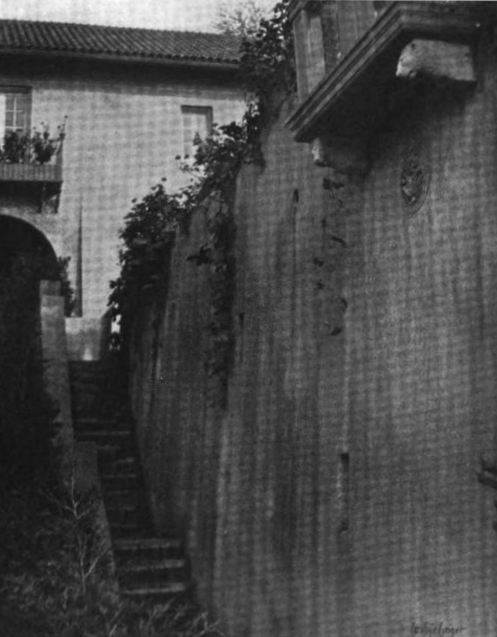 |
| NARROW STAIRWAY LEADING FROM "THE MONASTERY" THROUGH GREAT WROUGHT IRON GATES INTO A TUNNEL AND OUT TO THE HIGHWAY BORDERED WITH CEDAR TREES: NO RIOTOUS PLANTING COULD EQUAL IN BEAUTY THE BROAD SIMPLICITY OF THIS WALL. |
 |
| THE TALL CEDAR WAS TRANSPLANTED TO ITS PRESENT POSITION BY THE IVY-COVERED ARCHWAY: IN THE NICHE OF THE GATE-POST IS A SAINT. HOLDING A LANTERN TO LIGHT THE STRANGER ON HIS WAY. |
 |
| GOURD VINES ARE EXTENSIVELY USED IN "THE MONASTERY" GARDEN BECAUSE THEIR BROAD LEAVES CARRY OUT THE IDEA OF SIMPLICITY STRIVEN FOR: THE TREATMENT OF THIS BALCONY IS EXCEPTIONALLY FINE. |
 |
| INNER COURT OF "THE MONASTERY" THE HOME OF MRS FARQUHAR FERGUSON, HUNTINGTON, LONG ISLAND: GOLDFISH PLAY BENEATH THE LILY PADS OF THE CIRCULAR POOL. |
 |
| A WATER GARDEN that might be centuries old in Italy, designed by Caroline Geiger, for Mrs. F. Ferguson at Huntington, L.I. |
IF TWO distinct arts are represented in these four photographs, that of gardenmaking and that of picturemaking. Good photographs cannot be made in a minute or without thought, any more than a garden can be created in a season and by trusting to chance. There must be purpose in every bit of work done in gardenmaking and there must be quick appreciation of beauty and a patient waiting for the right opportunity to take it. Miss Geiger's photographs are not the result of chance or happy accident. She has spent many hours in this garden and knows well whether the strong noonday sun with its emphasis of deep shadows and high lights, or whether the soft harmonies of evening, produce the more perfect composition. The seasons also influence her choice of subjects. In the lacy fretwork of winter trees perchance she finds a more perfect picture than when the trees are in full summer garments. Miss Geiger like Mrs. Ferguson knows how to wait for just the right moment, how to catch the inspiration and develop it, in secret, until a perfect result is obtained.
Some gardens, though beautiful to look at, lose much of their beauty when under the searching lens of a camera; others, even small ones, compose naturally into wonderful lines. This "Monastery" garden seems to be built for picture making, so perfectly do its broad spaces, its masses of light and dark, lend themselves to an artist's desire. In these pictures also we note the beauty of photographic simplicity. If every leaf had been so focused upon that every vein was brought into prominence, the picture quality would be entirely lacking. These photographs catch the spirit as well as the facts of the garden, give us the ideal quality as well as the matterof-fact reality. They show us the home and garden as it would linger in memory, some details vague, others stamped indelibly upon the mind. Fact and fancy are balanced to perfection, a union reached only by an artist who creates as well as preserves beauty.
Click HERE to see the gatehouse from "The Monastery" at wikimapia(house demolished). You must visit Fergugson's Castle Reborn! Incomparable in scope, colorized versions of above photos and more, 3D models of castle, links to read chapters from Fergugson's Castle: A Dream Remembered by Robert King.
Tuesday, June 26, 2012
"Pidgeon Hill"
SEPTEMBER, 1920
"PIDGEON HILL" RESIDENCE of MEREDITH HARE, ESQ., Huntington, L.I. ~ Charles A Platt - Architect
By
HERBERT CROLY
 |
| FRONT ELEVATION -"PIDGEON HILL" RESIDENCE OF MEREDITH HARE, ESQ., HUNTINGTON, L. I. CHARLES A. PLATT, ARCHITECT |
This more wholesome attitude is expressed in the character and the design of the houses. There are comparatively few examples on Long Island of the pompous formality and the palatial pretentiousness which characterized so many houses erected by rich Americans during the last decade of the nineteenth century. More and more the builders of the new houses have started with their minds fastened on the kind of residence which an English country gentleman would wish rather than a seventeenth century nobleman; and this comparative unpretentiousness of outlook has released the architects of these buildings from the necessity of complying with many embarrassing and paralyzing demands. The newer houses have usually remained formal, which is a good thing, because sound architectural design requires a large infusion of formality; but their avoidance of mere informality and picturesqueness has not stood in the way of a great gain in individuality, in homeliness, and in domestic propriety. In many cases the houses bespeak a living relationship with the people who occupy them; and the people who occupy them possess standards and interests which are adapted to sincere, beautiful and significant expression. When the history of American domestic architecture of the existing generation comes to be written, the Long Island houses, particularly those built during the past twelve or thirteen years, will form the best and the richest material which the historian will have to use.
Long Island before the advent of the modern architectural movement possessed the advantage of a peculiar species of domestic design. The usual farmhouse of that region was not clap-boarded or sheathed but was shingled; and the shingles were somewhat larger in size than those used elsewhere, somewhat thicker and were painted white. Since in a wooden building so much of the effect depends upon the surface, the texture, and the delineation of the material, these Long Island shingles, super-imposed upon the generally good lines and appropriate details of the early farmhouse, created perhaps the most interesting type of small residence, for the use of the yeoman farmer, which was erected in this country. It certainly created a type which was more flexible than the New England farmhouse, and whose elements could be developed and varied without necessarily losing the merits of the original design. It is no wonder, consequent'y, that during the revival of domestic building that has recently taken place on Long Island the builders have frequently altered and enlarged the old farmhouses. In many cases they have succeeded in converting them from the residences of yeomen farmers into the residences of gentlemen farmers, without any falsification of the original type.
In some few instances, however, architects have perpetuated the type not merely in alterations but in an entirely new building. Such is the case with the house of Mr. Meredith Hare at Huntington, Long Island, designed by Charles A. Platt. The Hare residence is an excellent example of the very best qualities which are now characterizing American domestic architecture. It combines in a very happy way spaciousness with economy. Architects always find it difficult to design a house which locks ample enough to form the background for a liberal life without becoming wasteful of space; but in Mr. Hare's house, Mr. Platt has succeeded in excluding all superfluities while retaining an atmosphere of generosity and abundance. He has kept the scale and the general appearance of a Long Island farmhouse, which formed, of course, the background for anything but a spacious life; and without departing from the unpretentious simplicity essential to the type, he has designed a building which forms an entirely appropriate residence for people with leisure who prefer to devote the time, no longer occupied with the struggle for existence, to cultivating the arts and amenities of life. This house was designed, and successfully designed, for the purpose of providing an appropriate setting for the life of a particular family. When a nation educates architects who are capable of creating propriety of relationship between buildings and lives, and when the life which is expressed in the building possesses sincerity, distinction and value, it is by way of creating a domestic architecture which will endure, and deserve to endure, in the aesthetic consciousness of future Americans.
But, of course, a country house needs also another kind of propriety. It needs to fit not only the lives of its occupants, but also the particular site on which it is built. There are some residences, of which the Newport palaces form the perfect illustration, which can never become adapted to their sites. There are others, of which one finds so many examples in England, that, while they were not designed for their sites, have after a few hundred years grown into the landscape and now look as if they were always intended to be just where they are. Finally, there are others that only a few years after their erection look as if they had grown up on their site. They obtain their confirmation not from the weathering of time, but from their intimate relationship to the advantages and limitations of their immediate surroundings.
Among the many American architects who have made a personal contribution to American domestic architecture there is none who has so frequently succeeded in providing for his clients buildings which in a few years look as if they had been a very long time where they are. Mr. Hare's house does not look old yet. It is not old enough to settle down into its landscape with gentlemanly assurance and with complete self-possession. A few more years must elapse before it will become really mellow.
 |
| BLOCK PLAN -"PIDGEON HILL" RESIDENCE OF MEREDITH HARE, ESQ., HUNTINGTON, L. I. CHARLES A. PLATT, ARCHITECT |
 |
| FIRST FLOOR PLAN -"PIDGEON HILL" RESIDENCE OF MEREDITH HARE, ESQ., HUNTINGTON, L. I. CHARLES A. PLATT, ARCHITECT |
 |
| SECOND FLOOR PLAN - "PIDGEON HILL" RESIDENCE OF MEREDITH HARE, ESQ., HUNTINGTON, L. I. CHARLES A. PLATT, ARCHITECT |
 |
| FRONT PORCH - "PIDGEON HILL" RESIDENCE OF MEREDITH HARE, ESQ., HUNTINGTON, L. I. CHARLES A. PLATT, ARCHITECT |
 |
| GARDEN ELEVATION -"PIDGEON HILL" RESIDENCE OF MEREDITH HARE, ESQ., HUNTINGTON, L. I. CHARLES A. PLATT, ARCHITECT |
 |
| GARDEN ELEVATION -"PIDGEON HILL" RESIDENCE OF MEREDITH HARE, ESQ., HUNTINGTON, L. I. CHARLES A. PLATT, ARCHITECT |
 |
| DETAIL OF GARDEN ELEVATION -"PIDGEON HILL" RESIDENCE OF MEREDITH HARE, ESQ., HUNTINGTON, L. I. CHARLES A. PLATT, ARCHITECT |
 |
| DETAIL OF GARDEN ELEVATION -"PIDGEON HILL" RESIDENCE OF MEREDITH HARE, ESQ., HUNTINGTON, L. I. CHARLES A. PLATT, ARCHITECT |
 |
| EAST END OF TERRACE -"PIDGEON HILL" RESIDENCE OF MEREDITH HARE, ESQ., HUNTINGTON, L. I. CHARLES A. PLATT, ARCHITECT |
 |
| STAIR HALL -"PIDGEON HILL" RESIDENCE OF MEREDITH HARE, ESQ., HUNTINGTON, L. I. CHARLES A. PLATT, ARCHITECT |
 |
| LIBRARY AND LIVING ROOM -"PIDGEON HILL" RESIDENCE OF MEREDITH HARE, ESQ., HUNTINGTON, L. I. CHARLES A. PLATT, ARCHITECT |
 |
| DINING ROOM -"PIDGEON HILL" RESIDENCE OF MEREDITH HARE, ESQ., HUNTINGTON, L. I. CHARLES A. PLATT, ARCHITECT |
 |
| A SECLUDED SPOT -"PIDGEON HILL" RESIDENCE OF MEREDITH HARE, ESQ., HUNTINGTON, L. I. CHARLES A. PLATT, ARCHITECT |
Wednesday, June 13, 2012
"Rosemary Farm" Conservatory
A Conservatory Living Room Moderate In Cost -
***Clipped from a Lord & Burnham ad***
CONSERVATORIES are generally designed with special features to meet the personal idea of their owners. Seldom is consideration given to the fact that we have certain very attractive standard designs that when adaptable to the position, can be used at a decided saving.
Take this half span one illustrated; the standard sizes are 9 feet and 12 feet and 6 inches wide. In length 6, 25, 33, 41 and 50 feet. Let us know which one fits your needs, and we will promptly advise its approximate cost. The frame with its pleasing architectural lines, will be entirely of iron and cypress. Everything is cut, fitted and given a coat of paint at the factory before shipmcnt. Its erection speed will be a surprise to you. Having three factories, your conservatory would be shipped from the one securing to you the most favorable freight rates. Our Catalogue No. 309 you are welcome to. A representative will call on request.
Click HERE for a earlier post on "Rosemary Farm".
 |
| This delightful conservatory of R. R. Conklyn's(sic), at Huntington, L. I., may hold a welcome suggestion. |
 |
| Another glimpse to better show the so-called "under cover" portion. |
CONSERVATORIES are generally designed with special features to meet the personal idea of their owners. Seldom is consideration given to the fact that we have certain very attractive standard designs that when adaptable to the position, can be used at a decided saving.
Take this half span one illustrated; the standard sizes are 9 feet and 12 feet and 6 inches wide. In length 6, 25, 33, 41 and 50 feet. Let us know which one fits your needs, and we will promptly advise its approximate cost. The frame with its pleasing architectural lines, will be entirely of iron and cypress. Everything is cut, fitted and given a coat of paint at the factory before shipmcnt. Its erection speed will be a surprise to you. Having three factories, your conservatory would be shipped from the one securing to you the most favorable freight rates. Our Catalogue No. 309 you are welcome to. A representative will call on request.
Click HERE for a earlier post on "Rosemary Farm".
Wednesday, May 23, 2012
"Rosemary Farm"
"ROSEMARY - THAT'S FOR REMEMBRANCE": AND ROSEMARY FARM, THAT'S FOR LOVE AND MEMORY, TOO. ***unknown author - 1918***
THE most intangible and lovable quality about a country place is atmosphere, that air of charm and accrued memories which cannot be bought or built. It is usually the fruition of the years, an amalgam of nature and art and time. All along the shores of Long Island are coming into being great houses
beautiful grounds which a century hence may have
achieved atmosphere, but which today proclaim only the affluence and taste of their owners. The earth has not welded them to herself, they rest lightly on the ground, suns and storms have not mellowed their color, and birth, and death, and living have not yet made of them homes. The man who desires a mansion can secure one by the combination of a big architect and a big purse; but the man who desires to put into outward expression his ideal of home and hospitality must put himself into the job of home making from its inception to the end of his life.
The architect and the landscape artist have to be wary to keep man and his abode from being an intrusion on the landscape, and the larger the house the greater is the skill needed to weld the sophistication of our growing elegance with the gracious simplicities of nature. When a man marries himself to the land, he needs to feel a touch of the same glamour with which he marries his wife, and that will make the growth of a comely home a romance.
SOME forty miles from New York, there is such a place called Rosemary Farm, a Long Island estate of several hundred acres where beautiful things have been happening during the past decade. There were hills and lakes and woods and sea to begin with, and on the place Mr. Roland Ray Conklin found a little preRevolutionary farm house, clinging to the highway, as homes did when men were so scarce that every touch of human contact was desired. Just enough modern comfort was added to this farm house to make a living place for his family, while Mr. Conklin built the long red brick residence which tops the loveliest of his hills, commanding the wondrous Cold Spring Harbor, which looks like a Norwegian fiord in the low light of afternoon. Directly opposite are the beguiling involutions of Oyster Bay, while to the right a great sweep of the waters of the Sound meet the Connecticut Hills weaving into a blue horizon. From the living rooms and the terrace the pageant of the sunset crowns the day, while twilight comes first in the great cedars which sentinel the Open-Air Theatre set within a cleft between the house and the sea.
Brooding over the amphitheatre is a balustraded terrace, and beyond that the water front of the house, mellow with soft bricks and huge, adzed oak timbers. Numerous sleeping porches cling to its sides, without destroying the vigorous simplicity of its lines. The garden front has a more intimate overhanging quality, the great roof line in the center sweeping down to the mezzanine floor supported by carved caryatides. Vines have climbed to the gable tops, and the hedges are now man high.
The hospitable front door has a way of standing open even after Jack Frost pushes his way in, and through the reception hall comes the glow of immense logs whenever there is the slightest excuse to keep the hearth fires burning. The visitor gets an instant impression of dignity, beauty and homelikeness, but there is still another joy for the trained eye, which welcomes the realization that the ornament is constructive, not applied.
The carved figures on the arches and the stairway are part of the structural beams, and as one glances through the rooms, opening one from another, one realizes that all the richness expresses something inherent.
The living hall has a fine organ whose golden pipes blend with the dim, mysterious gorgeousness of the Panels of the Wise Men which line the walls. This organ once cast an aureate(gold) glow over the choir of an old Portuguese church. The room is lit by a lovely old metal lampidere colored in polychrome, which used to carry little lamps of oil above a high altar.
There is an Hispano-Moresque Cabinet of walnut, ivory and gold, chairs from an old Venetian palace, Russian brass, and other lares from far lands, which nevertheless blend so unobtrusively and quietly that they do not call the eye until after a full realization of the comfort and welcome of the room.
Beyond is the library, where upon the ceiling is woven a cunning design of arabesques, in the middle of each the symbol of one of the ancient formlers whose press assisted in the evolution of books.
In the owner's study are many beautiful specimens of bindings from the Kelmscott and Dove presses. Toward the east is the music room, panelled in grey and hung in soft blue. This room is also a theatre, having stage curtain and footlights. Beyond is the conservatory, paned in Welsh quarries and banked on three sides with masses of blooming plants, which change from month to month in color and form. On the fourth side is a tile-lined pool with mosses and ferns banked above it.
On the western side of the house are the dining room and breakfast room, the former with an impressive old Italian mantel, tapestries, and chairs made from the choir stalls of a Mediaeval French church. Twisted Venetian columns divide this from the breakfast room; through a hexagon of glass is seen the beauties of the waterways and the distant shores of lovely contour.
The circular dining table has a magic quality of growth, for the number of diners at this elastic board is generally an unknown quantity, since motorists dropping in for a five minute call have a way of still being there the following morning for breakfast. All the impediments you have left at home appear waiting for you in your room, and so friendly is this stately house that you conclude it matters little what you wear. If you are fortunate you may happen upon a Rosemary dinner, which means a meal provided entirely by the host, if we conscientiously exclude the salt. Oysters and clams grow on his shores, bread comes from his fields, fish from the bay, meat and game from his flocks, mushrooms, vegetables and fruits from his farm, sugar from his Cuban plantation, cream from his herds, and wine and liquors from his vineyards. There is even a Rosemary cocktail containing a sprig of Rosemary, and of a secret brew we none of us know, and lastly nut trees in a sheltered ravine, coaxed and sheltered to feel themselves near the tropics.
I remember seeing at Rosemary the full rose-tinted cups of seven thousand peach tree blossoms each holding in its corolla a rounded mound of snow. There were gray clouds, and gray stems to make an exquisite background for this Chinese acquerella, shimmering and silvery and roseate, but September saw very few peaches.
There is much still to be done at Rosemary, its owner has great dreams and plans for coaxing it to develop further allurements, but it has already achieved that entrancing quality - atmosphere. This is a place you do not forget, a haven well named, "Rosemary, that's for remembrance."
Vacant for many years house burned on December 27, 1990. Click HERE to see remains of "Rosemary Farm" at wikimapia. Follow additional links to Bing Maps and Historic Aerials from 1953 showing house still standing.
Learn more about Roland Conklin and "Rosemary Farm" by visiting oldlonisland.com. Find-A-Grave site for Roland Ray Conklin.
The Hoggson Building Method.
THE most intangible and lovable quality about a country place is atmosphere, that air of charm and accrued memories which cannot be bought or built. It is usually the fruition of the years, an amalgam of nature and art and time. All along the shores of Long Island are coming into being great houses
beautiful grounds which a century hence may have
achieved atmosphere, but which today proclaim only the affluence and taste of their owners. The earth has not welded them to herself, they rest lightly on the ground, suns and storms have not mellowed their color, and birth, and death, and living have not yet made of them homes. The man who desires a mansion can secure one by the combination of a big architect and a big purse; but the man who desires to put into outward expression his ideal of home and hospitality must put himself into the job of home making from its inception to the end of his life.
The architect and the landscape artist have to be wary to keep man and his abode from being an intrusion on the landscape, and the larger the house the greater is the skill needed to weld the sophistication of our growing elegance with the gracious simplicities of nature. When a man marries himself to the land, he needs to feel a touch of the same glamour with which he marries his wife, and that will make the growth of a comely home a romance.
 |
| ***"Rosemary Farm" Roland Conklin Estate - Huntington, NY - Circa 1924*** |
 |
| ***Open-Air Theatre - "Rosemary Farm" Roland Conklin Estate*** |
This theatre is perhaps the keynote of Rosemary, for the host finds even his big house so inadequate to satisfy his joy in sharing his acres, that he has built for the use of America this lovely amphitheater, which accommodates itself so fraternally with the place that there is no sense of intrusion. It never looks empty, and even at midnight, when Pelleas and Melisande, its two guardian swans, abandon their vigil in sleep, you can almost see Pan leave his stony base and call his people from the woods beyond the stage.
Brooding over the amphitheatre is a balustraded terrace, and beyond that the water front of the house, mellow with soft bricks and huge, adzed oak timbers. Numerous sleeping porches cling to its sides, without destroying the vigorous simplicity of its lines. The garden front has a more intimate overhanging quality, the great roof line in the center sweeping down to the mezzanine floor supported by carved caryatides. Vines have climbed to the gable tops, and the hedges are now man high.
 |
| WHITE MARBLE DOORWAY BROUGHT OVER FROM ITALY SETS THE TONE FOR THE LUXURIANCE OF THE INSIDE OF THE HOUSE: WROUGHT IRON GATES AND CARVING OVER THE DOORWAY ARE UNUSUALLY FINE. |
 |
| THE HALL AT ROSEMARY FARM WITH THE ORGAN IN THE DISTANCE: THE SPACE MADE BEAUTIFUL WITH RARE SPANISH ANTIQUE FURNITURE AND RICH POLYCHROME LIGHTING FIXTURES. |
 |
| A CLOSE VIEW OF THE ORGAN IN ONE END OF THE LIBRARYAT ROSEMARY FARM. |
There is an Hispano-Moresque Cabinet of walnut, ivory and gold, chairs from an old Venetian palace, Russian brass, and other lares from far lands, which nevertheless blend so unobtrusively and quietly that they do not call the eye until after a full realization of the comfort and welcome of the room.
 |
| A LIBRARY IN THE CONKLIN HOME ON LONG ISLAND N. Y. - DESIGNED AND EXECUTED UNDER THE HOGGSON BUILDING METHOD. |
 |
| ROOM OF THE ROLAND CONKLIN HOUSE, REMODELLED BY HOGGSON BROTHERS. FURNISHED WITH SPANISH LEATHER CHEST, CARVED CABINETS AND QUEEN ANNE CHAIRS. |
 |
| THE FIREPLACE IN THE DINING ROOM AT ROSEMARY FARM. |
The circular dining table has a magic quality of growth, for the number of diners at this elastic board is generally an unknown quantity, since motorists dropping in for a five minute call have a way of still being there the following morning for breakfast. All the impediments you have left at home appear waiting for you in your room, and so friendly is this stately house that you conclude it matters little what you wear. If you are fortunate you may happen upon a Rosemary dinner, which means a meal provided entirely by the host, if we conscientiously exclude the salt. Oysters and clams grow on his shores, bread comes from his fields, fish from the bay, meat and game from his flocks, mushrooms, vegetables and fruits from his farm, sugar from his Cuban plantation, cream from his herds, and wine and liquors from his vineyards. There is even a Rosemary cocktail containing a sprig of Rosemary, and of a secret brew we none of us know, and lastly nut trees in a sheltered ravine, coaxed and sheltered to feel themselves near the tropics.
 | ||
| A FLEMISH BED IN MASTER'S BEDROOM WITH RARE LACE COUNTERPANE BROUGHT FROM THE OLD WORLD AND A LANTERN BROUGIIT OVER FROM AN OLD WORLD CASTLE. |
There is much still to be done at Rosemary, its owner has great dreams and plans for coaxing it to develop further allurements, but it has already achieved that entrancing quality - atmosphere. This is a place you do not forget, a haven well named, "Rosemary, that's for remembrance."
Vacant for many years house burned on December 27, 1990. Click HERE to see remains of "Rosemary Farm" at wikimapia. Follow additional links to Bing Maps and Historic Aerials from 1953 showing house still standing.
Learn more about Roland Conklin and "Rosemary Farm" by visiting oldlonisland.com. Find-A-Grave site for Roland Ray Conklin.
The Hoggson Building Method.
Subscribe to:
Posts (Atom)