Showing posts with label Thomas Hastings. Show all posts

Monday, November 4, 2013

An Architects City Home - The Apartment of Thomas Hastings, Esq. on the Roof of a New York Office Building


THE IMPORTANT FEATURE IN THE PLAN OF THIS APARTMENT IS THE FIFTY-FOOT LIVING-ROOM BUILT IN STUDIO FASHION WITH OPEN CONSTRUCTION AND A WELL-SIMULATED BEAMED CEILING, ALTHOUGH BOTH ROOF AND WALLS ARE OF REINFORCED CONCRETE TO  COMPLY WITH THE   FIRE  LAWS. A DECORATIVE PIECE OF SEVENTEENTH-CENTURY FRENCH TAPESTRY HANGS ON THE SOUTH WALL HARMONIZING DELIGHTFULLY WITH AN ANCIENT NORMANDY WARDROBE OF THE SAME PERIOD, A CURIOUS OCTAGONAL TABLE OF ITALIAN DESIGN, AND CHAIRS OF PETIT POINT. CARVED-WOOD PANELS FLANK THE WINDOW GROUP. 


   A MAGNIFICENT HAND-CARVED AND GILDED ITALIAN FIREPLACE OF THE SEVENTEENTH CENTURY FORMS ONE OF THE NOTABLE FEATURES OF THE LIVING-ROOM. ONCE THE PROPERTY OF STANFORD WHITE, IT CAME INTO THE POSSESSION OF MR. HASTINGS A DECADE AGO. OF IMPOSING DESIGN, IT FITS INTO THE SETTING TO FORM AN INTERESTING COMPOSITION IN ASSOCIATION WITH THE TWO EIGHTEENTH-CENTURY VENETIAN CHAIRS IN RICH UPHOLSTERY OF BLUE  AND GOLD STRIPED SATIN.


   ANOTHER CORNER OF THE LIVING-ROOM. THE WALLS OF SOFT GRAY STUCCO SERVE AS AN EXCELLENT BACKGROUND FOR THE OLD FRENCH TAPESTRY, WHILE STRIPS OF HAND-CARVED WOODWORK OF ANCIENT ITALIAN ORIGIN ARE INGENIOUSLY WROUGHT INTO THE DECORATIVE TREATMENT. THE ENTIRE ROOM IS FURNISHED WITH A RARE COLLECTION  OF ANTIQUES.


   IN THE TWENTY-BY-THIRTY-FOOT DINING-ROOM, PAINTED ENGLISH FURNITURE IS USED AND A CORNER CUPBOARD OF INTERESTING DESIGN IS PAINTED TO MATCH THE OTHER PIECES. THE GATE-LEGGED TABLES, SILVER LAMPS AND SIDE LIGHTS, DESIGNED WITH MIRROR REFLECTORS, ARE QUITE IN KEEPING WITH THE PERIOD AS ARE ALSO THE PUTTY-COLORED PANELED WALLS HUNG WITH FAMILY PORTRAITS.

Click THIS LINK for more on Hasting's apartment on the roof of 52 Vanderbilt Avenue, New York, N. Y.


Monday, March 25, 2013

"Horsehaven" - Thomas Hastings in Aiken, S. C.

   "Horsehaven" was designed by architect Thomas Hastings around 1928 as his winter home.  Although Hastings is remembered for his large projects, such as the New York Public Library, he was interested in and wrote about the problems of designing the small house. This house is believed to express Hastings concept of small house design.  The lot on which "Horsehaven" is situated is approximately fifty feet wide and one hundred and fifty feet long.   The entrance to the residence is not on its street side; It is approached by a pathway through an arch in a high wall and on to an east-facing veranda.   The veranda looks out on an enclosed garden. Access to the garage and stable on the property is by a lane outside the garden wall. The two-story brick and frame house has a gable roof and at least three brick chimneys, a polygonal projection on the left of the facade and a polygonal bay window on the first story adds character to the front. 

Thomas Hastings fitted this modest house and stable into a fifty by one-hundred foot lot in Aiken, thus not only winning a wager from a skeptical friend, but ensuring that his wife could observe the horses from the house, as she could at "Bagatelle".

The little stable building is now a guesthouse. Photographed from the terrace, once the stable-yard.

Click HERE to see at wikimapia. BING. Google Street View.


  About the Civil War, Miss Celestine Eustis of New Orleans began to winter in Aiken, believing it to be healthy for her niece and ward, Louise Eustis.    An avid horsewoman, Louise Eustis came to love Aiken as a place where equestrian activities could be comfortably pursued during the winter months. 


  After Louise Eustis married, she convinced her husband, wealthy society sportsman, Thomas Hitchcock of New York, to continue wintering in Aiken.  Hitchcock also found Aiken ideal for horses and other sports and with Mrs. Hitchcock played a major role in Aiken's transformation from a health resort to a winter pleasure resort.  Along with Miss Eustis, the Hitchcocks encouraged their friends and family to spend the season in Aiken, thus forming the nucleus of healthy, wealthy, northern sports enthusiasts that became known as the Aiken Winter Colony. It was through this connection that  brought the Hastings to Aiken and led them to build "Horsehaven".   

"MON REPOS," RESIDENCE OF THOMAS HITCHCOCK


  During the heyday of the Winter Colony, Aiken was known as the "Winter Polo Capital of America."

Miss Celestine Eustis cookbook, Cooking in Old Creole Days, written in 1903.

Wednesday, March 6, 2013

Mr. Thomas Hastings' Apartment on the Roof of 52 Vanderbilt Avenue, New York


                        A Group of Distinguished Rooms

  Mr. Thomas Hastings' Apartment on the Roof of 52 Vanderbilt Avenue, Entirely Planned by Himself, Overlooks New York's Picturesque Roof-line from River to River

Photos by Drix Duryea

  The fireplace in the room ABOVE is antique Italian and once belonged to Mr. Stanford White.   The material back of the fireplace is 18th century red velvet, and the rug is Spanish Moresque of the 18th Century.

  The picture BELOW shows the view from Mr. Hastings' apartment over many tall office buildings. In front of the centre window is an old ship model.


Photos by Drix Duryea

Photos by Drix Duryea

  ABOVE is the living room of Mr. Hastings' roof apartment. The walls of this room are plaster in uneven surface in a yellow tone. Much of the woodwork is antique fragments of carved wood: the beams of the hipped roof are concrete cast in rough planks and painted to the tone of the rest of the wood.

  The picture BELOW is the library of Mr. Hastings' office. On all four sides the books go to the ceiling and there are some beautiful bits of old woodwork shown. The furniture as in the rest of the apartment is antique of course, much of it 17th century Italian as well as a Stewart table, an 18th century Italian chair and a quaint Sarvauarola chair against the wall.


Photos by Drix Duryea

  Hastings' penthouse was a later addition to the Vanderbilt Concourse Offices attributed to Architect A. Wallace McCrae. Carrere & Hastings had offices in the building. Previous offices were located HERE and HERE. Thomas Hastings' Long Island country home "Bagatelle" and a earlier home HERE.  John M. Carrere city home was located HERE, "Red Oaks" his summer home HERE.

 Platinum Equity, a private equity firm headquartered in Beverly Hills, Calif., has leased the penthouse floor of 52 Vanderbilt Avenue as the new location for the firm's New York office. In a press release on the lease it is mentioned the "vintage mantel" from Stanford White survives.


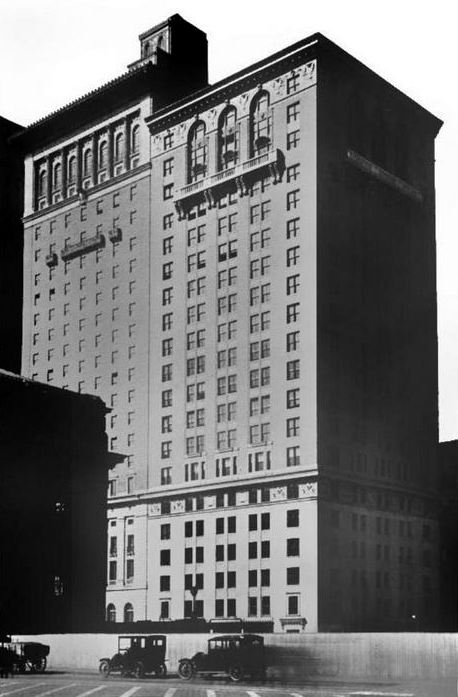
Vanderbilt Concourse Offices  Architecture and Building 1915

  The erection of this twenty-story structure in conjunction with the Grand Central improvement is the natural consequence of the neighborhood development caused by the Terminal improvements themselves. This building is essentially an office building and its over-all dimensions, little short of a 100 x 100, provide fourteen large sized offices on a story, although the area may be less sub-divided, to give larger office spaces.

  The connection with the subway and the Grand Central Terminal by the understreet sidewalk is an advantage to the tenants. There are five Otis traction elevators which run from the subway concourse in the basement to the full height of the building. The subway concourse runs through the basement of the building with a street entrance to East 45th street also.

  The mason contractors on the building were the Micwiel Co., Inc., and Clyde R. Place was the consulting engineer. The Reliance Fireproof Door Company did the kalamein work, consisting of the doors, windows and trim. The plain and ornamental plastering was done by T. A. O'Rourke, Inc., and the walls and ceilings are all finished with O'Brien's liquid wall finish. This finish throughout is very plain, as shown in the corridors and offices, but of a surface that is serviceable and easily cleaned. James McCullagh, Inc., held the plumbing contract for the building. There is a public toilet for men on each floor and in addition toilets for women on every third floor.


VANDERBILT CONCOURSE OFFICES ON EAST 45TH STREET, NEW YORK.
 Mason Contractors:  The Micwiel Co., Inc. Warren & Wetmore, Architects. Barrett Specification Materials. Clyde R. Place, Consulting Engineer. Kalamrin Doors, Windows and Trim:   Reliance Fireproof Door Co. Plumbing Contractors:   James McCullagh, Inc. ***NOTE THE ABSENCE OF THE PENTHOUSE***


Looking south from 47th Street - 1935 

VANDERBILT CONCOURSE OFFICES - FIRST FLOOR PLAN

VANDERBILT CONCOURSE OFFICES - SECOND FLOOR PLAN

VANDERBILT CONCOURSE OFFICES - 52 VANDERBILT AVENUE

VANDERBILT CONCOURSE OFFICES.   ELEVATOR HALL.
Plain and Ornamental Plaster;   T. A. O'Rourke, Inc.   Warren & Wetmore, Architects.

VANDERBILT CONCOURSE OFFICES.   ELEVATOR HALL AFTER A RECENT RENOVATION.

VANDERBILT CONCOURSE OFFICES.   ELEVATOR CORRIDOR IN AN UPPER STORY.
O'Brien's Liquid Velvet Wall Finish used on Walls and Ceilings.Stanley Butts

VANDERBILT CONCOURSE OFFICES.  AN INTERIOR OFFICE PARTITION OF GLASS TILE.
Partitions:   Keppler Glaus Constructions, Inc. Bommer Spring Hinges.

Google Maps

Wednesday, December 7, 2011

"Before Bagatelle"

Before building "Bagatelle" in Old Westbury Architect Thomas Hastings leased and altered this Port Washington, L. I. house.
The Colonial spirit preserved with remarkable success


"The house at Port Washington belongs to Congressman William Bourke Cockran("The Cedars"). It was leased for a term of years by Mr. Hastings who altered and added to it to suit his own ideas. This alteration cost about $10,000 - nearly as much as the cost of a new house. But Mr. Hastings has something which he could never get in any new house. It possesses that atmosphere of settled quiet that gathers about old things, while in fact it is hale, hearty and strong. There are charms in the Colonial porch, the broad dormers and the curve of the roof line which are matters of skillful design, but the house owes most to the splendid way in which the new has been added to the old."


Text from Country Life, 1906.


Two gatehouses(the sauce) survive  from the Cockran estate but I've yet to find this house.


Monday, December 5, 2011

"a thing of trifling importance"

"Bagatelle" Home of Architect Thomas Hastings.
From American Country Houses of Toady, 1915
THE DETAIL OF THE FRONT ENTRANCE WITH ITS INTERESTING DECORATION The portal is graceful. An interlacing arabesque decoration in color adds interest to vault overhead.
Here, in the birthplace of William Cullen Bryant's "Thanatopsis", we find the home of another, swayed by the love of the beautiful, the ideal. So closely is the house of Mr. Thomas Hastings snuggled up to the native woods near Roslyn, L. I., that it is well-nigh impossible to get an uninterrupted view of the southern frontage. We have to dodge under the great oaks on the terrace to see it at all in certain lights. It is some few years since Mr. Hastings built his first house in the woods of Roslyn. It was destroyed by fire two years ago and the present house is a rebuilding with some slight changes, but the original plan remains intact. The house is made a little longer by the addition of two porches, one on the east and the other on the west side. The long alley-way of linden trees, possibly the most successfully trimmed linden alley-way in this section of the country, the ivy-covered walling upon the other side of the court and the big oaks on the terrace fortunately remain unimpaired by the fire. The loggia decorations have been changed and repainted. The walls, seriously damaged, had to be pulled down and rebuilt. It is interesting to see that there is not any serious change. The plan remains. It was found to be workable and comfortable. It will always be remembered as the house which an architect built for himself. It is built in the woods without any remarkable view of the distance. The house is adapted to the trees. It is found, by careful study of the property, that a long, open vista opens through the center of the estate. It is this natural opening which has been accepted as the axial line. In a general way, the court runs northeast and southwest, and along that exposure, the outline of which the setting sun illumines so wonderfully, is a retaining wall, some eighteen feet in height.
"The appropriation for a house should be divided into two equal parts, one-half for the house, the other for the gardens, pathways, court, approach, terrace and the rest of it, or, as it might be termed, one-half for the pudding, the other for the sauce," as the architect facetiously said some time ago. Indeed, it seems to have been accepted as the general aim of the architect's office.
THE COURT IS CLOSED AT THE SOUTHERN END BY THE STABLES
The main entrance is in the far corner, and is partly concealed by tall cedars .
It is somewhat foolish to speak of it as a French, English or Italian house. It is a little of each. English, possibly in its enrichment within. The underside of the loggia has the decorative painting, which is French in detail. But the general plan is undoubtedly the product of American needs, American requirements. You feel that as you enter; you feel it as you examine the blue print plan, or as you study it in detail or mass. It is difficult to look at this very delightful entrance, with its central arch, its delicately painted barrel vaulting and slender marble columns, without recalling vividly the loggia to the Pazzi chapel at Santa Croce, Florence, by that indomitable little personality, Filippo Brunelleschi, the enthusiastic comrade 
THERE IS A DELIGHTFUL AIR OF PRIVACY AND PROTECTION IN THE COURT The white light of the picture is the marble fountain, and the arched entrance beyond it
of Donatello and, for a time, of Ghiberti. In its graceful proportion, it recalls not a little the arcade of the portico of Saint Annunziata and Spedale degli Innocenti. There is an Etrurian influence to be seen in the cap and elsewhere. This house is the work of a man who determined to indulge himself in just one little architectural note, and that as infinitely beautiful as he could possibly make it. It is of white marble, an exquisite detail like the little Saint Ambrose chapel of the Cathedral of Saint John the Divine, but recently completed and dedicated to daily service. It is the accent of the house. The rest of the house is fearlessly, deliciously, almost impertinently bereft of the usual, I might almost say, the too usual trimmings, thought essential to an architectural composition of any moment. It is of hard, well burnt brick.
FROM THE COURT WE GET THE ACADEMIC ACCENT AS WLLL AS THE PICTURESQUE SETTING Here is a delightful study in textures and color. Romance plays an Important part in the planting. The fountain is a relic of old Verona .

ONE OF THE DIFFICULT THINGS TO TREAT IN A HOUSE IS THE STAIRCASE The wrought-iron balustrading is introduced from an interesting old European fragment.

Within, it is full of color. The wall of the hall is blue. It is by means of a red-tile staircase that we climb to the upper story. The balustrading is of wrought-iron, taken from a fragment of old work which Mr. Hastings fortunately found in Europe. The ceiling is an old Italian painter's work of considerable merit, and very beautiful and low in tone. The dining-room is an English example of wall panelling of the eighteenth century. The painting of the ceiling is of a religious significance of the same period. The library, the largest room in the house, is a portion of the original building, 

SHOW ME THE HOUSE AND I WILL INFORM YOU OF THE MAN. The library of a student, alive to the importance of practical affairs, and a lover of beauty.

 which survived the fire. It was rebuilt in part. The owner is fond, among other things, of maps, charts, plans and surveys. Above the books are lockers, an ingenious contrivance whereby the maps may be hauled down or rolled up, as you will, out of sight but forever within reach.
The unfortunate fire, which destroyed so much of the house that it had to be rebuilt from start to finish, gives us a very pleasing side-light upon the skill of the distinguished owner, who happens to have been his own architect. To me it is interesting to see that it was rebuilt, not redesigned, because it shows a confidence in the former judgment and that the house had been excellent, gratifying all expectations. There is a subtle satisfaction in this when we realize how few houses survive the intimate relation of daily life! Do they not too often resemble people, in that while our friendship may be delightful and satisfying for a time, a protracted acquaintance might prove fatal. The qualities that win, sometimes fail to hold. Very prettily do 
THIS SUGGESTS THE COMFORT AND RESTRAINT OF AN ENGLISH DINING-ROOM The accent is the decoration of the ceiling and the painting of Augustus St. Gaudens near window.

certain people attract by the bright sparkle of their wit, oft basking in the sunshine of their own verbosity, as Beaconsfield used to say, while the audience applauds in the offing and things go well and the goose hangs high! But they tire, they weary and even applause bores. Yes, many houses are very much like people of whom we experience sad disappointment.
The accompanying sketch shows that a large portion of the Roslyn estate remains practically in its original condition. Much of it is not even enclosed with a fence. So insidiously has the architect added to the scene a well devised house with accompanying outbuildings and garden that the romance and beauty of the property is unimpaired. The building stands on a small elevated plateau surrounded by dense woods. Look at the sketch. The house court with barn, gardener's cottage and garage are enclosed with a high wall. By the planting of a long pleached avenue of linden trees additional shelter and a strong decorative accent has been given, forming the westerly side of the court.
SKETCH PLAN OF PORTION OF PROPERTY
The views show informal vista from terrace to arbor and general location of things. It reveals pathways and varying levels. Woods are supplemented in places by small trees of their own kind. MR. THOMAS HASTINGS' HOME AT ROSLYN, L. I. 207
 Beyond the terrace pavement, descending some thirty feet or more, are the meadow and vegetable garden you passed as you arrived from the station, only so entertained were you by the extended grape vine covered pergola skirting the roadway that you failed to see it all. Even the observant fail to catch some of the beautiful green things such as the dwarf mountain mugho pine bushes which cover in an irregular fashion the surface of the slope. These effective little evergreens from the mountains of Switzerland are very serviceable, being of the type which clings to the ground, resembling somewhat juniper and enriching without darkening.
The principal rooms are indicated upon the plan. A is the entrance hall, B the living room, C the dining room, D the library. There are two mentions of the letter E, which mark the little loggia at each end of the house. The sketch also shows the southern and westerly terrace and the hedging of box or privet which accents desirable boundaries. Here is the green of the forest, that is, of the natural Long Island woods, plus the acquired green bushes of varying kinds planted between the larger oaks as seemed essential to intensify a certain well-defined climax. It is very peaceful; in color it is green, the green of a thousand palettes, with all the modifications the Oriental mind can conceive, and it is a sunshiny place.
Vases, and wide, open-mouthed pots, low squat tubs with sturdy box, laurel and magnolia trees, jars reminding us of the famous Arabian Nights story of The Forty Thieves, a well head, sedilia and fountain from one of the southern principalities of the energetic King Rene, who strove in the good Renaissance days to restore to art and letters some semblance of the regard in which the ancients had held them, occupy prominent places in the court. They assail our hearts with a thousand memories. Some will recall with delight the Oriental prince who, among many other occupations, was enamoured of the gentle art of gardening, and who, while enjoying the designing of large places whose dignity and inches required the larger frame of nature, clung tenaciously to little inanimate things which to him were ever alive. He treasured these for the messages they whispered to him of old civilizations never far distant. The earthen jar into wich Marjaneh poured the boiling oil so thoughtlessly upon the forty thieves is not only a nursery romance but a decorative note. It strikes a key in the kingdom of the painter as inspiringly as a dandelion-bestarred meadow or the fugitive smile on the countenance of his fair mistress.
In a whimsical mood, Mr. Hastings named the house "Bagatelle" an Italian word absorbed by the French, the true meaning of which is "a thing of trifling importance." And, architect-like, he supplements with a motto —Parva sed apta, "small but fit."


For more on "Bagatelle" -
http://www.oldlongisland.com/search/label/Bagatelle

"Bagatelle" at wikimapia.org - http://wikimapia.org/#lat=40.7921659&lon=-73.6093318&z=17&l=0&m=b&show=/2119513/Bagatelle

Sunday, December 4, 2011

Architect Thomas Hastings

THOMAS HASTINGS was born in I860, the son of the Rev. Thomas Hastings, an eminent Presbyterian divine, who was for years the president of the Union Theological Seminary in New York. His mother was a Miss de Groot, an American of Dutch and French parentage.
He received his professional education at the Ecole des Beaux Arts, studying in the atelier of M. Jules Andre, and took the full course in the Department of Architecture. Mr. Hastings has had many honors conferred upon him for his eminence in his profession. He is a chevalier of the Legion of Honor, decorated by the French Government, a director of the Museum of French Art, a corresponding member of the Royal Vienna Association of Architects, an academician of the National Academy of Design, a member of the Federal Commission of Fine Arts in Washington, a member of the American Academy of Arts and Letters, chairman of the Lincoln Highway Commission, a fellow and director of the American Institute of Architects, and has been president of the Architectural League. In 1884 he formed a partnership with the late John M. Carrere.
To appreciate the varied work of Mr. Hastings, from his first burst of exuberance in the Ponce de Leon Hotel to the restraint of the Frick house in New York, there must be an understanding of the sensitive qualities of his mind to the subtleties of expression, the modulations of composition, the pleasure in delicate detail, and even the delights of fantasy. From whatever source he gleans an inspiration, whether it be from Spain or from his beloved France, he penetrates the spirit of his chosen example and saturates himself with its character before he translates it into a new creation which has become a part of himself. His choice is that of a classicist who is eclectic within a selfimposed range which seldom is sympathetic with the Gothic spirit. That this is the case is natural; for his mind, though alert in fancy, seeks expression in formulated terms, in intellectual conventions, produced from serious study. He can better endure enthusiasm controlled by precedent than exuberance breaking a path to new vistas. Therefore his work manifests not only the good taste of his appreciation, but also that of training. Whether it be broad and simple, or decorative and complex, a refinement of line and of surface, of arrangement and of light and of shade, all give evidence of the careful study it has received. —C. H. W.


Lifted from The Brickbuilder 1915.