TWIN GARDENS in a TUDOR SETTING
Many Wise and Lovely Suggestions are Made by This Double Rose Garden Whose Accent Is Early English - MINGA POPE DURYEA
- Dix Duryea, photographer
 |
| From the pool-set tapis vert which separates the two rose gardens the house stands above its broad terrace with the unmistakable air of the 16th century England, though it is new and its site Long Island. Hobart Sherman is the owner and James W. O'Connor the architect. |
ROSE gardens rarely find, as they have found here, the prominence they deserve. From few but the most enthusiastic fanciers do they rate the finest situations, the places of honor. And the real reason for this cannot lie far from the fatc that rose gardens which are simply and solely rose collections lack the luxuriant beauty that is found in the individual blossom. They very much need "design". There must be interest and beauty in the shape and arrangement of the beds, a pattern must exist to satisfy the eye when flowers and foliage fail. Where an herbaceous garden could reach extraordinary heights of loveliness without having any particular plan, a rose garden, without the same body and brilliance, needs to rely upon neatness and precision and an interesting disposition of its parts.
When a rose garden gets this sort of treatment, intelligently and with taste, then it can assume its rightful importance. It can be THE garden. It need no longer be something to visit at certain hours in certain seasons when the bloom is on the bush. Always it will shine. And no other flower merits as much such a careful setting.
In every rose garden there is apt to be a considerable amount of exposed earth in the beds. The wide spacing desirable for most types and varieties makes this necessary, and while it is possible to mask this bare earth with some ground covering plant like Forget-me-not or Horned Violets, such a practice, however lovely its effect, interferes naturally with the cultivation of the soil. It is generally a better plan to leave the ground uncovered and make it attractive by keeping it immaculately smooth and well raked. The plants themselves should be set in exactly regular lines, the outside line being kept always an even distance from the paths.
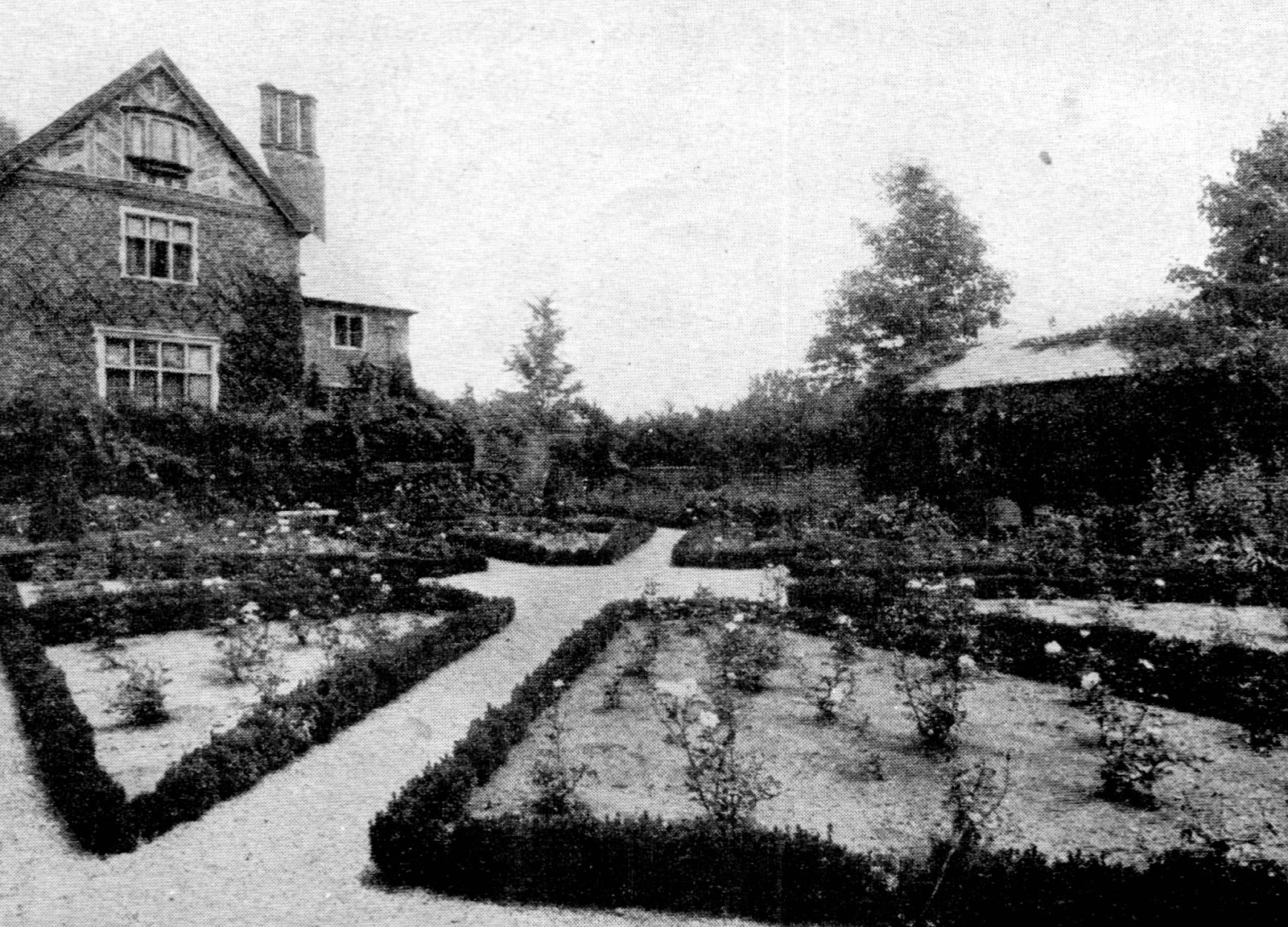 |
| Each of the gardens is a box-lined rose parterre of the period set in a colorful herbaceous border. In every other respect like its mate, this garden sports a shaded arbor |
Almost more than in any other type of garden the paths in a rose garden should be emphasized, for they actually create the design. Their color should contrast with the color of the earth in the beds, and their edges should be sharply defined. If the paths are made of some loose material, such as gravel, an edging of brick or tile or plank on edge should be given them in order that the juncture of bed and path may always be clean-cut. Dwarf Box, kept low and neatly clipped, makes a splendid dark emphatic edging. With paved paths most of the edging problems vanish, for their own line is always crisp and certain.
 |
| Geometrical designs are generally more effective for rose gardens than simpler shapes, because the outlines of the beds must assert themselves when flowers and foliage fail |
The plan of this twin garden above makes these points clear. And because every detail has been made interesting and beautiful they sit effectively in their fine positions. In each garden a wide perennial border, massed from spring to fall with color in flower and foliage, extends about the four sides. It is hardly practical to combine roses and herbaceous plants in the same bed, but when they are kept distinct, each acting as a complement to the other, then something has been done to add materially to the continuous beauty of the rose garden.
Click HERE for a earlier post on "North Hills".
Interesting side to the author of this article - Minga Pope Duryea - she was sister to Architect John Russell Pope. Minga first married Harry H. Duryea(starch), who reportedly committed suicide, then wed Hasley Patchin, who worked for W. R. Grace and Company. She died in 1957 - published in the New York Times on 9 July 1957, page 29, which reads in part, "Mrs. Minga Pope Duryea Patchin, artist, sculptor and author, died Friday in Central Valley, N. Y....Mrs. Patchin was the sister of John Russell Pope, internationally known architect, who died in 1937...Born in New York City, Mrs. Patchin attended private schools here and studied painting in Paris and Rome...She was known particularly for her portraits...Her first husband, Harry H. Duryea, died in 1921...After his death she went to Europe to study famous houses and gardens, accompanied by her son, Hendrick Vanderbilt Duryea, who photographed them...On her return she wrote a series of articles for House and Garden magazine. She also wrote and published a book, 'Gardens In and About Town'."
Patchin painted historic scenes on porcelain plates of New York, and the patriotic American Eagle breakfast-room service for "Hillwood" commissioned by Marjorie Merriweather Post in 1938.
Henry Vanderbilt Duryea(namesake), born 1901, died 29 August 1976, and married to Pauline Bourne, who died in December 1983. All of these persons are buried in the Duryea plot at the Woodlawn Cemetery in the Bronx, New York–including Minga (Pope) (Duryea) Patchin.
I've come across the photographs of Dix Duryea before but do not know if there was a family connection with Minga.